

How Roast-to-Order Coffee Works: Fresh Beans Delivered
Table of Contents
- What Roast-to-Order Coffee Actually Means
- How the Roast-to-Order Process Works: Step by Step
- Coffee Freshness Timeline: When Your Beans Arrive at Peak Flavor
- Understanding the Coffee Degassing Process
- Best Way to Store Roasted Coffee Beans at Home
- Coffee Roast Levels Explained: Impact on Flavor Profile
- Shipping and Logistics: From Roastery to Your Door
- Why Roast-to-Order Costs More: Financial Sustainability Explained
Last Updated: August 2, 2026
Understanding how roast to order coffee works is essential for coffee enthusiasts seeking the freshest possible beans. At Gospel and Grind, we've spent years perfecting the roast-to-order process to ensure every cup delivers maximum flavor and aroma. This guide explains the complete journey from green bean to your doorstep, revealing why fresh-roasted coffee tastes dramatically different from inventory-based alternatives and how the science of degassing impacts what you experience in your morning brew.
What Roast-to-Order Coffee Actually Means
Roast-to-order coffee is roasted specifically after you place an order, rather than sitting in warehouse inventory for weeks or months. With inventory-based roasting, roasters prepare large batches weeks in advance and ship from stock. Roast-to-order flips this model: your order triggers the roasting process, with beans going from green (raw, unroasted) to roasted to shipped within days.
Coffee begins losing volatile aromatic compounds the moment it's roasted. A bean roasted three weeks ago has undergone significant oxidation compared to one roasted two days ago. When you brew coffee roasted last week versus last month, the difference in aroma intensity and flavor clarity is immediately noticeable.
Gospel and Grind uses roast-to-order because our mission centers on delivering premium quality to conscious consumers. By roasting only when you order, we eliminate the guesswork about how long beans have been sitting.
How the Roast-to-Order Process Works: Step by Step
The roast-to-order workflow involves several coordinated steps, each critical to delivering fresh beans at peak flavor.
Green bean storage and sourcing begins months before your order arrives. Gospel and Grind sources single-origin and carefully blended green coffee beans from trusted farms. Green beans are remarkably stable and can be stored for 6-12 months without significant degradation when kept in proper conditions with controlled temperature and humidity.
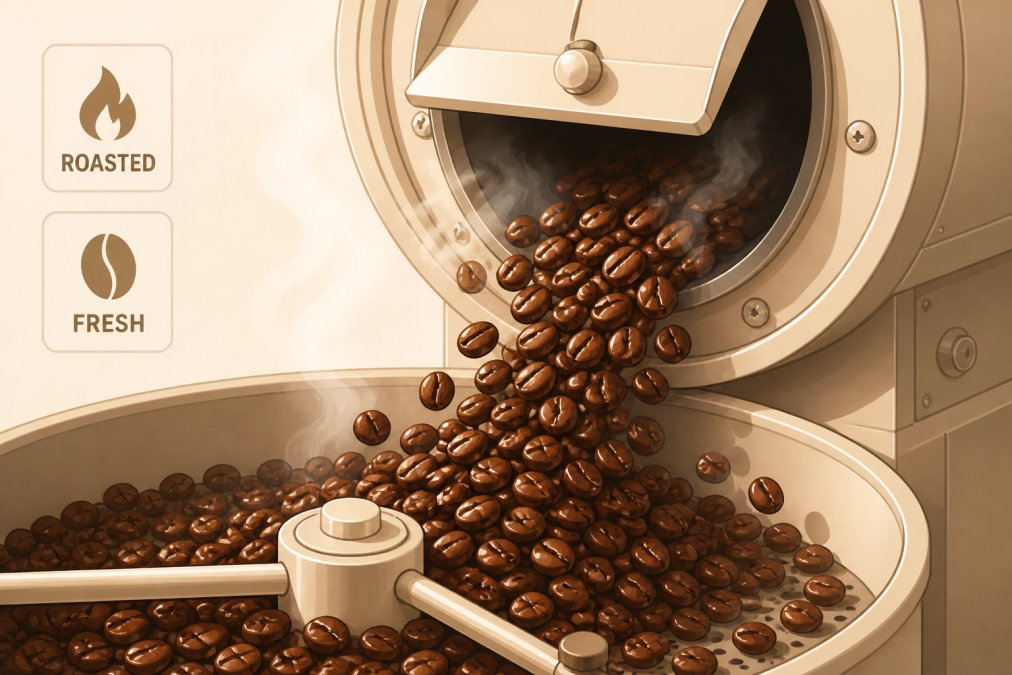
When your order comes through, the roastery pulls the appropriate green beans from climate-controlled storage, weighs them, and prepares them for the roasting drum. This step typically takes 15-30 minutes from order confirmation to roasting start.
The roasting workflow and thermal energy control is where the magic happens. The roaster loads green beans into a drum that rotates while applying heat. As thermal energy transfers to the beans, their internal structure transforms. Moisture evaporates, oils develop, and chemical reactions create hundreds of flavor compounds. The roasting process takes 10-18 minutes depending on the desired roast level and bean density.
During roasting, the roaster monitors temperature, airflow, and color development, listening for the "first crack", a popping sound when internal pressure causes the bean to split slightly, marking the transition from light to medium roast. A second crack indicates the onset of dark roast. Roast curves (the temperature progression over time) vary dramatically based on the coffee's origin and the roaster's style.
Quality control in small-batch roasting happens continuously. Small batches (typically 5-25 pounds) allow roasters to catch inconsistencies immediately. If a batch shows uneven color development or off-gassing issues, it can be set aside before packaging. Larger commercial roasters working with 100+ pound batches cannot make these adjustments mid-roast.
After roasting, beans are cooled rapidly using air or water cooling systems, stopping the roasting process and preventing over-development. Once cooled, beans are weighed, packaged, and labeled with the roast date.
| Step | Duration | Purpose |
|---|---|---|
| Green bean storage | 6-12 months | Preserve raw beans in stable condition |
| Order to roasting start | 15-30 minutes | Pull beans, weigh, prepare drum |
| Roasting | 10-18 minutes | Apply heat, develop flavor compounds |
| Cooling | 2-5 minutes | Stop roasting, stabilize beans |
| Packaging | 5-10 minutes | Seal with one-way valve, label |
| Degassing | 12-48 hours | Release carbon dioxide |
| Shipping | 2-5 days | Transport to customer |
Coffee Freshness Timeline: When Your Beans Arrive at Peak Flavor
Coffee freshness follows a predictable arc. Understanding this timeline helps you brew at the optimal moment.
Days 1-3 after roasting: Beans are still actively releasing carbon dioxide (CO2). They're not yet ready for brewing. The CO2 trapped inside the beans interferes with water absorption during brewing, leading to uneven extraction and sour flavors. Most roasters recommend waiting until day 3 or later before opening the bag.
Days 5-14 after roasting: This is the peak window for most brewing methods. Flavor compounds are fully developed, CO2 has largely escaped, and the beans haven't yet begun significant oxidation. Espresso typically peaks around day 7-10. Pour-over and French press coffees often taste best around day 5-7 when acidity is bright and body is clean.
Days 15-30 after roasting: Coffee remains drinkable but begins losing aromatic volatility. The flavor profile becomes flatter, acidity decreases, and body softens. Many specialty coffee drinkers notice the difference immediately.
Day 30+: Coffee is stale. It's still safe to drink but has lost much of what makes fresh-roasted coffee special.
Gospel and Grind's roast-to-order model ensures you receive beans around day 2-5 post-roast, letting you wait the recommended 3 days if needed, then enjoy your coffee during the peak freshness window.
Understanding the Coffee Degassing Process
Degassing is the release of carbon dioxide that accumulates during roasting. This process is invisible but scientifically critical to flavor extraction.
Why carbon dioxide release matters for flavor comes down to how water interacts with coffee grounds. CO2 is created when heat breaks down organic compounds inside the beans. Immediately after roasting, beans contain significant trapped CO2 (roughly 1-2% of the bean's mass).
When you brew coffee too soon, this CO2 escapes during brewing instead of allowing water to fully penetrate the grounds. The result is under-extraction: sour, thin flavors because water didn't contact enough soluble compounds. As beans rest, CO2 gradually escapes through the bean's porous structure. After 3-4 days, most of the gas has released, allowing water to fully saturate the grounds and extract the full flavor profile.
Research from the Specialty Coffee Association's brewing standards confirms that optimal extraction occurs when beans are 3+ days post-roast for most methods. This is measurable through total dissolved solids (TDS) and flavor panel testing.
The one-way valve and post-roast resting work together. Roasted coffee bags include a one-way valve (also called a degassing valve) that lets CO2 escape while preventing oxygen from entering. Without the valve, CO2 pressure builds inside the bag and forces it open, allowing oxygen in and accelerating oxidation. With the valve, CO2 escapes freely while the bag stays sealed, protecting the beans during shipping and storage.
Best Way to Store Roasted Coffee Beans at Home
Storage conditions directly impact how long your roasted coffee stays fresh. The four enemies of roasted coffee are heat, light, moisture, and oxygen.
An airtight container in a cool, dark cabinet is ideal. Glass jars with rubber seals work well. Opaque containers are better than clear ones because light degrades flavor compounds. A kitchen cabinet away from the stove and sunlight is perfect. Room temperature (65-75°F) is optimal.
Many coffee enthusiasts use specialized coffee canisters with built-in one-way valves. These mimic the packaging valve and allow residual CO2 to escape while sealing out oxygen.
Never store coffee in the refrigerator or freezer. Temperature fluctuations cause condensation, introducing moisture that accelerates staling. Whole beans stay fresh longer than ground coffee. Grinding dramatically increases surface area exposed to oxygen, accelerating oxidation. If you grind at home, do it immediately before brewing.
Once opened, consume roasted coffee within 2-3 weeks. After that, oxidation becomes noticeable in the cup. Gospel and Grind recommends buying smaller quantities more frequently rather than stockpiling large amounts.
Coffee Roast Levels Explained: Impact on Flavor Profile
Roast level, light, medium, or dark, fundamentally changes flavor, body, and acidity.
Light roasts are removed from the drum just after the first crack. The beans are light brown, and the roasting time is shortest (10-12 minutes typically). Light roasts preserve the most origin characteristics. You taste the terroir, the specific flavor notes of the farm's soil, elevation, and climate. Light roast coffees have bright acidity, lighter body, and pronounced fruit or floral notes. These coffees work beautifully in pour-over and drip methods.
Medium roasts are removed between the first and second crack (12-15 minutes). Medium roasts balance origin flavors with roasted flavors. You get some of the bean's inherent characteristics plus the caramel, chocolate, and nutty notes developed by heat. Medium roast coffees have moderate acidity and body and are versatile, excellent in espresso, French press, or drip. Gospel and Grind's signature blends are typically medium roasts because they appeal to the widest range of brewing methods.
Dark roasts are removed after the second crack (15-18 minutes). Dark roasts emphasize roasted flavors over origin flavors. You taste chocolate, smoke, caramel, and sometimes spice, regardless of where the beans came from. Dark roast coffees have lower acidity and fuller body and work well in espresso and milk-based drinks.
How to visually identify roast quality involves looking at color consistency and surface appearance. High-quality roasts show even color across all beans with no pale beans mixed with dark ones. The bean surface should have a slight sheen but shouldn't look greasy or wet. Excessive oil indicates over-roasting.
Shipping and Logistics: From Roastery to Your Door
Roast-to-order coffee requires coordinated logistics to arrive fresh. When you order, Gospel and Grind roasts your beans and packages them within 24 hours. The package includes the one-way valve to manage ongoing degassing during transit. The roast date is printed clearly on the label.
Shipping typically takes 2-5 days depending on your location. USPS Priority Mail and UPS Ground are the standard carriers. The package is designed to protect beans from temperature extremes and physical damage. During transit, your coffee continues degassing naturally. The one-way valve ensures CO2 escapes while the seal prevents oxygen from entering. By the time your package arrives, the beans are 4-7 days post-roast, exactly in the sweet spot for peak flavor.
According to the Specialty Coffee Association's supply chain guidelines, roasted coffee should be shipped in sealed, opaque packaging with proper ventilation valves. Gospel and Grind meets these standards with every order. Roast-to-order coffee spends days in transit, then goes directly into your hands, eliminating the longest bottleneck of traditional coffee: warehouse storage.
Why Roast-to-Order Costs More: Financial Sustainability Explained
Roast-to-order pricing is higher than mass-market alternatives because the operational model differs fundamentally. Traditional coffee roasters achieve economies of scale by roasting massive batches (500-1,000 pounds), spreading labor and energy costs across huge volumes. They then warehouse this coffee for weeks or months, accepting the loss of freshness to achieve low prices.
Roast-to-order roasters operate differently. Each roast is smaller (5-50 pounds typically). Labor cost per pound is higher because setup, monitoring, and cleanup aren't spread across massive batches. Energy cost per pound is also higher because smaller roasts require proportionally more energy for heating and cooling.
Roast-to-order also requires flexible staffing, one-way valve bags that cost more than standard packaging, and smaller shipments with higher per-unit shipping costs. The financial trade-off is intentional. Gospel and Grind chooses roast-to-order because the freshness justifies the cost. You're not paying for marketing or warehouse overhead, you're paying for roasters' expertise, fresh beans, and rapid delivery.
Many customers find that roast-to-order coffee requires less total consumption because the flavor is so much better. A smaller cup of fresh-roasted coffee is more satisfying than a large cup of stale coffee. Over time, the cost difference narrows.
Fresh-roasted coffee transforms your daily ritual from routine to intentional. When you understand how roast to order coffee works, you can make informed decisions about where your beans come from and when they were roasted. Gospel and Grind specializes in roasting only after you order, ensuring maximum freshness and flavor in every batch. Our carefully sourced single-origin and blended beans arrive at your door 4-7 days post-roast, during the peak freshness window. Beyond exceptional coffee, every purchase supports our mission to fight homelessness. Find Your Perfect Roast and experience the difference fresh-roasted coffee makes.
Frequently Asked Questions
What does roast-to-order coffee mean, and how is it different from store-bought?
Roast-to-order coffee is roasted after you place your order, not weeks before. Store-bought beans sit in warehouses or on shelves, losing freshness through oxidation and aroma loss. With roast-to-order, your beans reach peak flavor within days of roasting. The primary difference is timing: inventory-based roasting prioritizes shelf life; roast-to-order prioritizes flavor. Most specialty roasters roast to order to ensure you receive beans at their optimal freshness window, typically 3-14 days after roasting depending on the roast level and bean density.
How long does it take for roast-to-order coffee to arrive, and will it really be fresher?
Most roast-to-order services roast your beans within 1-3 days of receiving your order, then ship immediately. Depending on your location and shipping logistics, delivery typically takes 2-5 business days. Yes, it will be significantly fresher. A bean roasted and shipped within a week is still releasing carbon dioxide and developing its flavor profile, whereas grocery store coffee may be 2-6 months old. The freshness difference is noticeable in aroma, acidity, and body. One-way valves on packaging allow degassing during shipping without exposing beans to oxygen.
Is roast-to-order coffee actually worth the extra cost compared to bulk buying?
The financial sustainability question depends on your brewing habits and palate sensitivity. Roast-to-order costs more upfront because each batch is smaller, roasting happens on demand, and supply chain efficiency is lower than mass production. However, you avoid waste: bulk-bought beans lose flavor over weeks, so you're paying for staleness. If you brew 4+ cups daily, roast-to-order typically pays for itself through superior flavor and reduced staling. If you brew occasionally, buying smaller quantities of fresh beans still beats buying large quantities that oxidize. Factor in your brewing method: espresso machines and pour-overs highlight freshness differences more than drip machines.
How can I tell if coffee is truly roasted to order versus just marketed that way?
Look for a roast date on the package, not a 'best by' date. Legitimate roast-to-order roasters print the specific date beans were roasted. Check the supply chain transparency: can you see which farm the single-origin beans came from? Roast-to-order roasters typically provide batch-specific roasting profiles and may share development time details (how long beans spent in the roaster). Ask about their green bean storage practices. Reputable roasters store green beans at controlled temperature and humidity to preserve moisture content and bean density. If a company won't share a roast date or sourcing details, it's likely inventory-based despite marketing claims.
What's the best way to store roasted coffee beans once they arrive?
Store beans in an airtight container away from light, heat, and moisture. A sealed jar with a one-way valve is ideal because it lets carbon dioxide escape during degassing without letting oxygen in. Keep beans at room temperature (65-75°F) in a dark cupboard, not above the stove or near a window. Avoid the freezer unless you plan to store beans longer than 4 weeks. Once opened, use beans within 2-3 weeks for optimal flavor. Grind just before brewing to minimize oxidation. Proper storage preserves the roast profile and acidity you paid for, extending the freshness window from the roast date.
This article was written using GrandRanker