

Impact of Water Quality on Coffee Flavor
Table of Contents
- Why Water Quality Changes What You Taste in the Cup
- Minerals, Alkalinity, and pH: How Chemistry Shows Up in Flavor
- Hard Water, Soft Water, and What Each Does to Your Brew
- How to Test Water Hardness for Coffee at Home
- Water Filtration Systems for Coffee: What Each Type Actually Removes
- The Best Water for Coffee Brewing: A Simple Target Profile
- Matching Water to Roast Profile and Protecting Your Equipment
- Frequently Asked Questions
Last Updated: September 26, 2026
Why Water Quality Changes What You Taste in the Cup
The impact of water quality on coffee flavor is the most overlooked variable in home brewing, and it is decisive: brewed coffee is roughly 98% water by mass, so dissolved minerals shape what your palate registers. This guide from Gospel and Grind breaks down the chemistry in plain terms, then gives you a target profile you can hit with ordinary kitchen tools, how to test your tap water, choose a filtration system, and adjust your brew so the beans you paid for taste like themselves.
Minerals, Alkalinity, and pH: How Chemistry Shows Up in Flavor
Minerals in brewing water do two jobs: they pull flavor compounds out of the grounds, and they buffer the acids that make coffee taste lively. Get the balance right and you taste clarity; get it wrong and you taste sourness or dull, chalky flatness.
Magnesium vs. Calcium: Two Minerals, Two Jobs
Magnesium ions bind to coffee's fruity and acidic compounds more readily than calcium does, so a higher magnesium-to-calcium ratio tends to produce a more vivid sensory profile. Calcium is less selective and contributes more to body and mouthfeel than to flavor clarity. Both are desirable; more of either is not better.
Alkalinity and pH: The Buffer That Decides Brightness or Flatness
Alkalinity is the water's capacity to neutralize acid, and it matters more than pH itself for most brewers. High-alkalinity water mutes the bright, acidic notes in light roasts and can push a cup toward bitterness; low-alkalinity water lets acidity come through, sometimes too aggressively in under-extracted brews. pH balance sits downstream: pH tells you where the water sits on the scale, alkalinity tells you how hard it will fight to stay there.
Hard Water, Soft Water, and What Each Does to Your Brew
Water hardness is the combined concentration of dissolved calcium and magnesium, usually reported in ppm as calcium carbonate equivalent. Hard water, generally above roughly 150 ppm, over-extracts and can leave a dry, chalky finish. Soft water, below about 50 ppm, under-extracts and produces thin, sour, or hollow cups.
| Water Type | Approx. Hardness | Typical Brew Result | What to Do |
|---|---|---|---|
| Hard tap water | Above 150 ppm | Dry, chalky, muted acidity | Dilute or filter |
| Moderately hard | 75-150 ppm | Balanced, workable | Test, then adjust lightly |
| Soft tap water | 50-75 ppm | Slightly thin, bright | Often fine as-is |
| Very soft / RO | Under 50 ppm | Sour, hollow, weak | Remineralize |
| Distilled | Near 0 ppm | Flat, lifeless | Remineralize fully |
How to Test Water Hardness for Coffee at Home
You can test your brewing water at home in under five minutes with a strip test or a digital meter. Strips give a rough hardness band; a total dissolved solids meter gives a precise ppm number for under the cost of a bag of beans.
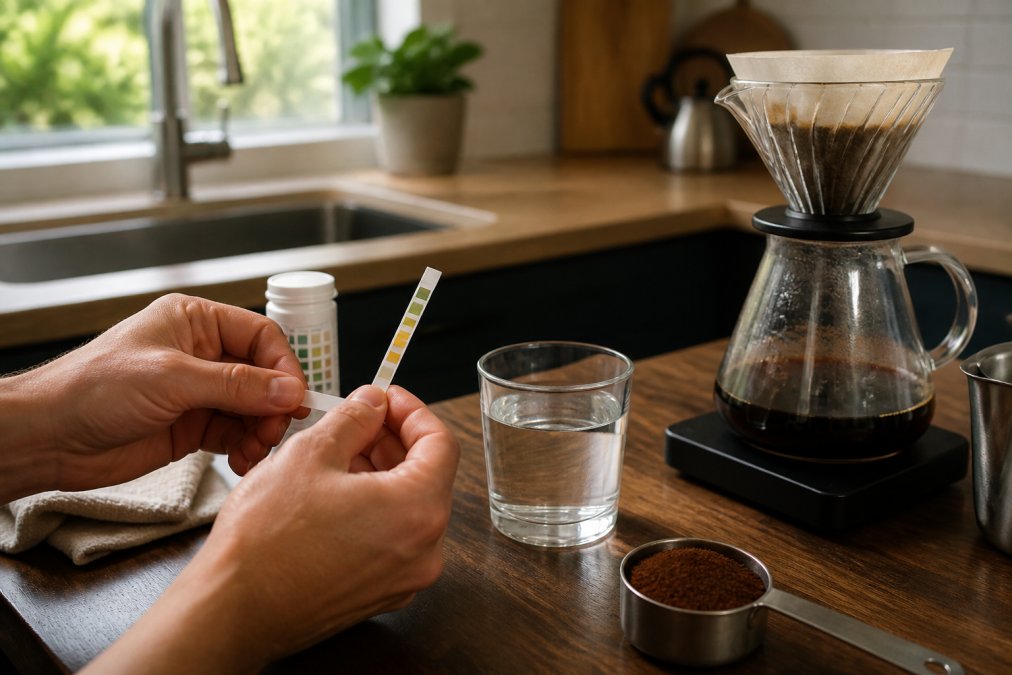
Here is the workflow I recommend:
- Fill a clean glass with cold tap water and let it sit uncovered for a few minutes so any residual chlorine taste dissipates.
- Dip the test strip for the time stated on the packaging, then compare the color against the chart.
- For a number rather than a band, calibrate a TDS meter with distilled water, then submerge the probe and wait for the reading to stabilize.
- Write down both the TDS reading and the strip result, plus the date.
- Brew the same coffee twice, once with tap water and once with filtered water, and taste them side by side.
Water Filtration Systems for Coffee: What Each Type Actually Removes
Filtration systems for coffee fall into three practical categories, each removing a different set of contaminants. Choosing well means deciding what you actually need gone: chlorine and odor, hardness minerals, or everything.
Ion Exchange, Reverse Osmosis, and Carbon Filters Compared
Carbon filters remove chlorine, chloramine, and many off-flavor organic compounds while leaving minerals largely intact, ideal if your water is already in a reasonable hardness range. Ion exchange swaps calcium and magnesium for sodium or hydrogen, softening water and reducing scaling, but does not lower alkalinity much. Reverse osmosis strips out nearly everything, including the minerals you want, so remineralization becomes mandatory.
| System | Removes | Leaves Behind | Best For |
|---|---|---|---|
| Carbon filter | Chlorine, odor, organics | Most minerals | Good-tasting tap water |
| Ion exchange | Calcium, magnesium | Alkalinity, sodium | Hard water areas |
| Reverse osmosis | Nearly all minerals | Almost nothing | Known contamination |
The Best Water for Coffee Brewing: A Simple Target Profile
The best water for coffee brewing sits in a moderate range: roughly 75-125 ppm total dissolved solids, hardness around 50-100 ppm as calcium carbonate, and alkalinity between 40 and 70 ppm. This is not a narrow window you must hit exactly, but a zone where extraction stays consistent and flavors read clearly.
DIY Water Recipes and When to Remineralize Distilled Water
Remineralizing distilled water is the most controllable approach, and simpler than it sounds once you stop eyeballing it. Most home brewers fail because they add "a pinch" of this and "a splash" of that, then wonder why the cup changes weekly. The fix: build two stock concentrates and dose them by the milliliter so every batch is reproducible.
The two concentrates you need:
- Magnesium concentrate: Dissolve Epsom salt (magnesium sulfate) in distilled water at roughly 1 gram per 10 milliliters of distilled water, yielding a concentrate you can dose in small increments.
- Buffer concentrate: Dissolve baking soda (sodium bicarbonate) in distilled water at a similar ratio, roughly 1 gram per 10 milliliters. This is your alkalinity lever.
- Start with 1 gallon of distilled or reverse osmosis water.
- Add roughly 2-4 milliliters of the magnesium concentrate. This lands you in the neighborhood of 20-40 ppm magnesium, which most practitioners find gives good extraction of fruity and acidic compounds.
- Add roughly 1-2 milliliters of the buffer concentrate. This puts alkalinity in the 30-50 ppm range, enough to keep brightness in check without flattening it.
- Stir thoroughly, then test TDS. You are aiming for the 75-125 ppm zone.
- Brew a small batch and taste. If the cup tastes sour or thin, nudge the magnesium up slightly. If it tastes flat or chalky, you have over-buffered, so reduce the baking soda next time.
Why this matters more than buying "coffee water":
Tailoring Water Chemistry to Roast Profiles
A single "ideal" water profile does not exist, because light and dark roasts respond differently to the same minerals.
Matching Water to Roast Profile and Protecting Your Equipment
Water choices do double duty: they change flavor today and your equipment over months. That second effect is why a machine that brewed beautifully in year one can taste noticeably worse in year three with no change to beans or technique.
How Scale Buildup Silently Rewrites Your Flavor Profile
Hard water leaves calcium carbonate deposits, known as scaling, inside kettles, espresso machines, and drip reservoirs. Scale is not cosmetic: it is an insulating layer, and insulation changes how heat moves.
Matching Water to Roast and Equipment Together
The practical rule: match your water to your roast and your equipment at once, and treat scale potential as a hard constraint for any machine you care about.
- Light roasts: lower alkalinity (roughly 20-40 ppm), higher magnesium ratio, protect flavor clarity. In a pour-over, this is straightforward. In an espresso machine, pair lower alkalinity with low scale potential by starting from filtered or diluted water rather than hard tap.
- Medium roasts: mid-range profile (40-70 ppm alkalinity), easiest to satisfy, works across most equipment.
- Dark roasts: slightly higher buffer (60-80 ppm), softer acidity, fuller mouthfeel. Just watch total hardness so you are not trading flavor for scale.
- Espresso machines: prioritize low scale potential above all. A blend of filtered and reverse osmosis water, remineralized to your target, gives you flavor control without feeding the boiler.
- Drip brewers and kettles: scale still matters, but the tolerance is higher than for espresso. A carbon filter that leaves moderate hardness intact is often fine if you descale on a regular schedule.
A Maintenance Habit That Protects Flavor
If you brew espresso or use a kettle daily, descale on a schedule tied to your water hardness, not a calendar reminder you ignore. Hard water areas may need it every few weeks; soft water areas can go months. Watch for a change in how long your machine takes to reach temperature, or a shift in shot time with no change to grind or dose, scale is the likely culprit, and the fix is mechanical, not a new bag of beans.
Frequently Asked Questions
Does water quality really affect coffee taste?
Yes, and more than most brewers expect. Coffee is roughly 98-99% water, so the minerals and compounds in your brewing water shape how coffee solubles dissolve and how you perceive acidity, sweetness, and bitterness. Water with the right mineral balance and alkalinity produces flavor clarity; water that is too hard, too soft, or high in chlorine flattens the cup or adds off-flavors. Changing your water is often the single biggest upgrade you can make before buying new gear.
What is the best water for coffee brewing?
Aim for water with total dissolved solids around 75-125 parts per million, moderate hardness, and alkalinity near 40 ppm as calcium carbonate. Magnesium ions help extract fruity and bright notes, while a small amount of calcium supports body and mouthfeel. Avoid distilled water on its own because it lacks the minerals needed for proper extraction. If your tap water misses these targets, a carbon filter plus remineralization or a bottled low-mineral water gets you close.
How do minerals in water change coffee flavor?
Magnesium binds to coffee solubles and pulls out fruity, acidic compounds, which sharpens flavor clarity. Calcium adds body and roundness but can mute delicate notes when it dominates. Bicarbonate acts as a buffer: too much and it neutralizes the acids that make coffee taste lively, leaving it flat and dull; too little and the cup turns sharp and thin. The ratio of these minerals matters as much as the total amount.
Can hard water damage my coffee machine?
Yes. Hard water leaves calcium carbonate deposits, a process called scaling, inside kettles, boilers, and espresso machines. Scale builds up on heating elements, slows water flow, raises brewing temperature inconsistency, and shortens equipment life. If your water tests above roughly 150 ppm hardness, use a filtration system designed for coffee equipment or switch to a lower-mineral water source. Regular descaling helps, but preventing scale in the first place is easier and cheaper.