

Best Coffee Brewing Methods for Strong Coffee
Table of Contents
- Strong Coffee Brewing Methods Compared
- Immersion vs. Percolation: How Water Meets Coffee
- Coffee to Water Ratio for Strong Coffee
- Best Grind Size for Strong Coffee
- How to Make Coffee Taste Stronger
- French Press, Moka Pot, and Pour-Over Techniques
- Budget vs. Pro-Grade Equipment for Strong Coffee
- Frequently Asked Questions
Last Updated: September 16, 2026
Strong Coffee Brewing Methods Compared
Strong coffee is a cup with a high ratio of dissolved coffee solids to water, which is why extraction, not caffeine, decides how bold a brew tastes. This guide breaks down the best coffee brewing methods for strong coffee, from immersion to percolation, and explains the grind, ratio, and temperature settings that separate a syrupy shot from a bitter, over-extracted mug. Below, you'll find a comparison table so you can match a method to your kitchen and your taste. Most guides treat "strong" as a caffeine question; the real lever is how much flavor you pull out of the grounds.
Here's the core distinction worth understanding before you buy another bag: perceived strength and caffeine content are two different things, and they don't always move together. A dark, oily roast can taste intense while carrying less caffeine than a lighter bean brewed the same way. That gap is where most home brewers get stuck.
Immersion vs. Percolation: How Water Meets Coffee
Immersion brewing steeps grounds fully submerged in water, while percolation pushes water through a bed of grounds under gravity or pressure. The method you choose determines how evenly the coffee extracts and how much control you have over strength. Immersion methods like French press and cold brew tend to produce a heavier body because the grounds stay in contact with water the whole time. Percolation methods like pour-over and espresso rely on flow rate, and they reward a consistent grind. If you want a concentrated cup with minimal fuss, immersion is the more forgiving starting point.

Coffee to Water Ratio for Strong Coffee
The coffee to water ratio for strong coffee sits between 1:12 and 1:15 by weight, meaning one gram of coffee to twelve to fifteen grams of water. Standard drip usually lands near 1:17, so tightening the ratio is the fastest way to a bolder cup. Weigh your grounds rather than scooping them; volume measurements vary wildly with grind size and bean density. Start at 1:15, taste, then step down toward 1:12 if you want more intensity. Push past 1:12 and you risk a muddy, under-extracted flavor rather than a clean, concentrated one.
| Method | Coffee-to-Water Ratio | Grind Size | Typical Contact Time |
|---|---|---|---|
| French press | 1:12 to 1:15 | Coarse | 4 minutes |
| Moka pot | 1:10 to 1:12 | Fine-medium | 5 minutes |
| Pour-over | 1:15 to 1:16 | Medium | 3 minutes |
| Cold brew | 1:5 to 1:8 concentrate | Coarse | 12-18 hours |
| Espresso | 1:2 | Fine | 25-30 seconds |
Best Grind Size for Strong Coffee
The best grind size for strong coffee depends on your brewer, but coarser grinds suit immersion and finer grinds suit pressure and paper filters. Grind size controls how much surface area the water can reach, which directly shapes extraction speed. Too fine in a French press and you'll clog the mesh and drink silt; too coarse in a pour-over and water races through, leaving a weak, sour cup. Match the grind to the method, then adjust one notch at a time. A burr grinder gives you repeatable settings, which matters more for strength than any single recipe.
How to Make Coffee Taste Stronger
To make coffee taste stronger, increase the dose, tighten the ratio, and raise water temperature slightly before you change anything else. Adding more grounds is the most reliable lever; extending brew time is the least predictable, because it pulls bitterness along with flavor. Water temperature between 195°F and 205°F extracts efficiently without scorching. Agitation during the first pour, often called the bloom, helps release trapped gases so water can reach the grounds evenly. If your cup still tastes thin, the problem is usually the roast profile or the freshness of the beans, not your technique.
Roast Profile and Caffeine Extraction
Roast profile changes flavor intensity far more than it changes caffeine. Darker roasts develop bolder, smokier tasting notes and a heavier mouthfeel, which reads as "strong" even when caffeine content stays flat or drops slightly. Caffeine extraction efficiency also depends on contact time and water temperature, not roast darkness alone. If you want both a bold flavor profile and more caffeine, look for a blend built with robusta, which naturally carries more caffeine than arabica. Our overview of coffee chemistry from the National Coffee Association explains how roasting and extraction interact.
French Press, Moka Pot, and Pour-Over Techniques
Each of these three methods reaches a concentrated cup through a different mechanism, and each rewards a different grind. The French press is full immersion with a metal mesh filter, so it keeps oils and produces a rich body. The Moka pot uses steam pressure to push water up through fine grounds, landing close to espresso in intensity. Pour-over relies on a paper filter and a slow, controlled pour, giving you the cleanest cup of the three but the least body.
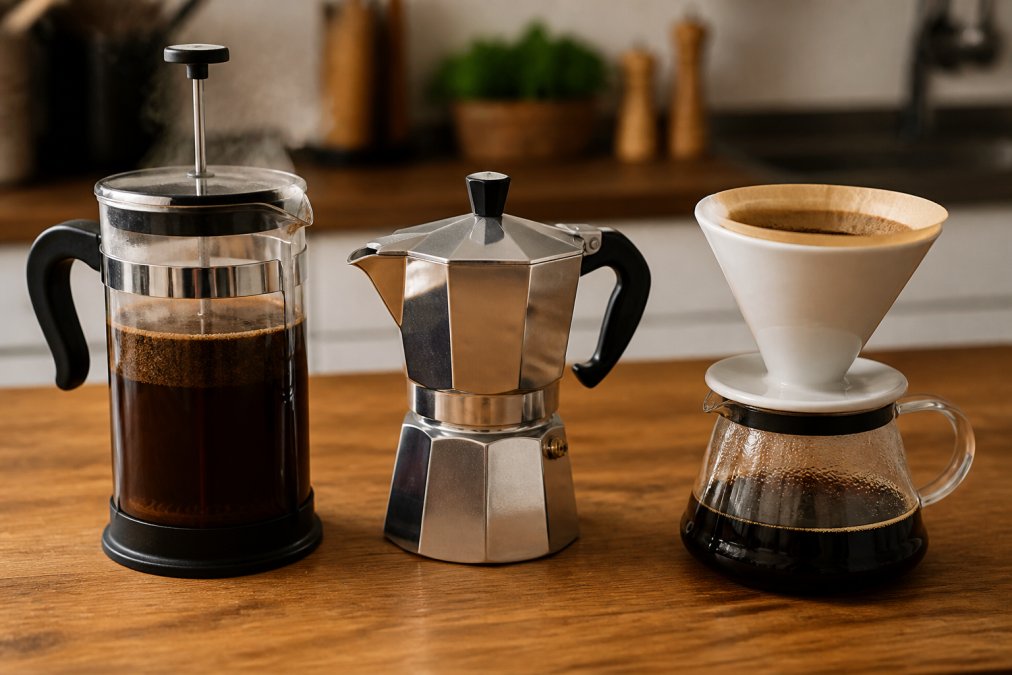
French Press
Use coarse grounds and a 1:13 ratio, steep four minutes, then press slowly.
Moka Pot
Fill the basket level with fine-medium grounds, never tamp, and pull it off the heat as soon as it gurgles.
Pour-Over
Bloom the grounds with a small pour, wait thirty seconds, then pour in slow circles.
Which Method Is Actually Strongest?
Strength has two meanings, and the methods split on them.
| Method | Perceived Strength (TDS) | Caffeine per 8 oz | Why |
|---|---|---|---|
| Espresso | Highest | Moderate per serving | Concentrated, but a 1 oz shot uses a small dose |
| Moka pot | High | High | Larger dose plus pressure extraction |
| French press | Medium-high | High | Long contact time extracts more caffeine |
| Pour-over | Medium | Medium-high | Single pass, but a full 8 oz dose |
| Cold brew | Medium (diluted) | High | Long steep, then diluted to taste |
Cold Brew Concentration
Cold brew reaches strength through time and ratio rather than heat.
Budget vs. Pro-Grade Equipment for Strong Coffee
| Setup | Key Gear | What It Controls | Typical Cost Band | Strength Ceiling |
|---|---|---|---|---|
| Entry | French press, blade grinder, kitchen scale | Ratio and steep time only | Under $60 | Good, but inconsistent particle size caps clarity |
| Budget-plus | French press or Moka pot, hand burr grinder, 0.1 g scale | Ratio, steep time, repeatable grind | $60-$150 | High; burr grinder is the single biggest jump |
| Mid-range | Moka pot or pour-over cone, gooseneck kettle, digital thermometer, scale | Grind, temperature, pour rate | $150-$350 | High with more control over bitterness |
| Pro-grade | Espresso machine with PID, precision burr grinder, pressure gauge | Pressure, dose, temperature, flow | $700 and up | Highest concentration, but only if you dial in |
Freshness sits alongside gear as a strength variable. Beans roasted to order and shipped soon after roasting hold their flavor profile longer than bags that sat on a shelf, and peak flavor fades within weeks of roasting, per the Specialty Coffee Association's guidance on freshness. Gospel and Grind roasts to order and delivers to your door, which keeps that window tight.
Frequently Asked Questions
What brewing method makes the strongest coffee?
Espresso and Moka pot produce the most concentrated cups by forcing hot water through fine grounds under pressure. For a strong drip or immersion brew, a French press with a high coffee-to-water ratio and coarse grounds delivers a full-bodied, strong coffee. Cold brew concentrate also ranks high because steeping time and high grounds-to-water ratio extract intense flavor without bitterness.
How does grind size affect the strength of my coffee?
Grind size controls extraction speed. Fine grounds expose more surface area, so water extracts flavor and caffeine faster. For strong coffee, use a finer grind with short contact time (espresso) or a coarser grind with long steeping (French press). The best grind size for strong coffee depends on your method: too fine in a drip machine causes over-extraction and bitterness, while too coarse in a pour-over leads to weak, under-extracted coffee.
What is the ideal coffee-to-water ratio for a bold cup?
A standard coffee-to-water ratio for strong coffee is 1:15 or 1:14 by weight. For example, use 20 grams of coffee to 300 grams of water. If you prefer a more intense cup, tighten the ratio to 1:12. Adjust gradually: start at 1:15, taste, then add more coffee or reduce water until the flavor profile matches your preference.
Can you make strong coffee without an espresso machine?
Yes. A French press, Moka pot, or cold brew system can all make strong coffee without an espresso machine. Use a higher coffee-to-water ratio, a grind size suited to the method, and adequate steeping time. For example, a French press with a 1:12 ratio and 4-minute steep yields a concentrated, full-bodied cup. A Moka pot on a stovetop produces espresso-like strength with fine grounds and pressure.
Choosing the right method is only half the equation; the beans you start with set the ceiling on how strong and how good your cup can taste. Gospel and Grind roasts to order for maximum freshness, sources beans from trusted farms, and delivers directly to your door, with every purchase helping fight homelessness one cup at a time. Find your perfect roast and brew a bolder cup tomorrow morning.