

Arabica vs Robusta Coffee Beans: Key Differences
Table of Contents
- Arabica vs Robusta Coffee Beans: A Quick Comparison
- What Are Arabica Coffee Beans?
- What Are Robusta Coffee Beans?
- Caffeine Content in Arabica vs Robusta
- Flavor, Body, and Acidity: What Each Bean Brings to Your Cup
- Growing Conditions, Altitude, and Disease Resistance
- How to Tell If Coffee Beans Are Fresh
- How to Store Coffee Beans for Maximum Freshness
- Frequently Asked Questions
Last Updated: September 15, 2026
Arabica vs Robusta Coffee Beans: A Quick Comparison
The difference between Arabica and Robusta coffee beans comes down to four things: species, caffeine, flavor, and growing conditions. Arabica (Coffea arabica) is the smoother, more acidic bean that dominates specialty coffee. Robusta (Coffea canephora) carries roughly double the caffeine, tastes earthier and more bitter, and grows in tougher climates for less money. This guide from Gospel and Grind breaks down every distinction so you can choose the right bean for your brewing method and palate.
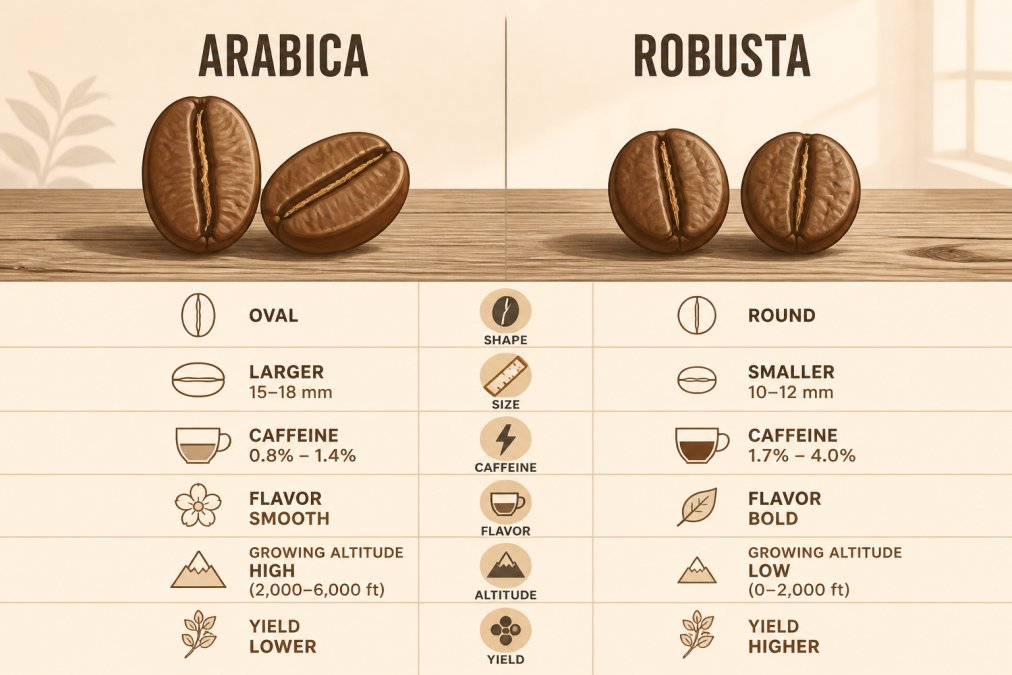
| Feature | Arabica | Robusta |
|---|---|---|
| Species | Coffea arabica | Coffea canephora |
| Caffeine content | About half that of Robusta | Roughly double Arabica |
| Flavor profile | Sweet, fruity, floral, higher acidity | Earthy, nutty, bitter, low acidity |
| Bean shape | Oval, larger, curved split line | Round, smaller, straight split line |
| Growing altitude | Higher elevations | Lower elevations |
| Disease resistance | Lower | Higher |
| Price | Higher | Lower |
The sections below cover flavor, caffeine, cultivation, freshness, and storage, so you can pick a bean with confidence.
What Are Arabica Coffee Beans?
Arabica coffee beans are the seeds of Coffea arabica, the species behind most of the world's specialty coffee. The bean is prized for its sweetness, layered acidity, and aromatic complexity, which is why most single-origin and pour-over coffees are Arabica.
A few defining traits:
- Oval shape with a gently curved split line down the center
- Lower caffeine concentration than Robusta
- Higher lipid and sugar content, which supports sweetness and body
- Grown at higher altitudes where cooler temperatures slow cherry maturation
That slower maturation matters. It gives the bean more time to develop the sugar concentration and aromatic compounds that show up as floral notes or fruity tones in the cup. The trade-off is fragility: Arabica plants are more vulnerable to pests and disease, which pushes production costs up. The Specialty Coffee Association's green coffee guidance outlines how grading standards separate specialty-grade Arabica from commodity lots.
What Are Robusta Coffee Beans?
Robusta coffee beans are the seeds of Coffea canephora, a hardier species that thrives at lower altitudes and resists disease far better than Arabica. That resilience is why it remains a staple in espresso blends worldwide.
What sets Robusta apart:
- Rounder, smaller bean shape with a straight split line
- Roughly twice the caffeine of Arabica
- Earthy, nutty, sometimes woody flavor with pronounced bitterness
- Lower acidity and a heavier, more viscous mouthfeel
- Higher yield per hectare and lower cultivation cost
The bitterness is not a flaw. In an espresso blend, Robusta builds crema, adds body, and cuts through milk, which is why traditional Italian espresso relies on it. Italian Roast from Gospel and Grind leans into this tradition, a slow-roasted blend of specialty-grade Arabica and Robusta that shows how the two species work together rather than compete.

Caffeine Content in Arabica vs Robusta
Robusta contains roughly twice the caffeine of Arabica by weight, and that fact drives most buying decisions. But the gap is more specific than "double," and the exact numbers matter.
The raw numbers. Green Arabica typically lands around 1.2% caffeine by weight, while Robusta runs between 2.2% and 2.7%. The reason is evolutionary: caffeine is a natural pesticide, and Robusta evolved in lower, warmer, pest-heavy environments where a stronger chemical defense paid off. Arabica, growing at altitude with fewer threats, never needed to invest as much energy in caffeine production.
What that means in the cup. Caffeine is water-soluble and extracts early, so the difference shows up fast. An 8-ounce drip cup from pure Arabica delivers roughly 95 mg; the same cup from pure Robusta lands closer to 150-200 mg. An espresso shot tells the same story: about 60-65 mg from Arabica versus 100-110 mg from Robusta. Figures shift with dose, grind, and brew ratio, but the ratio between species stays consistent.
| Brew | Arabica (approx.) | Robusta (approx.) |
|---|---|---|
| 8 oz drip | ~95 mg | ~150-200 mg |
| 1 oz espresso | ~60-65 mg | ~100-110 mg |
| 12 oz cold brew | ~150-200 mg | ~250-300 mg |
Why blends exist. A 70/30 Arabica-to-Robusta blend lands in a middle zone most drinkers find ideal: enough caffeine to feel it, enough Arabica to keep the cup clean. That is the logic behind most traditional espresso blends and commercial high-caffeine products. Max Caf Blend from Gospel and Grind combines Tanzania and India Robusta for a high-caffeine cup that still drinks smooth, and Breakfast Blend + adds Robusta to a medium-roast house blend for extra caffeine.

The roast myth. A persistent belief holds that dark roasting "burns off" caffeine. It does not. Caffeine is heat-stable well past roasting temperatures, and the small losses that occur are negligible. A dark-roasted Arabica still has Arabica-level caffeine, and a light-roasted Robusta still has Robusta-level caffeine.
Decaf is a separate question. Decaffeination removes 97% or more of caffeine regardless of species, so decaf Robusta and decaf Arabica end up in roughly the same place.
Flavor, Body, and Acidity: What Each Bean Brings to Your Cup
Flavor is where the two species diverge most, and the divergence is not random. It comes down to measurable differences in sugars, lipids, and acids, the fastest way to predict what a bean will taste like before you brew it.
The chemistry behind the cup.
- Sugars. Arabica carries roughly 6-9% sucrose by weight; Robusta carries closer to 3-5%. Sucrose feeds the Maillard and caramelization reactions during roasting, so more sugar means more sweetness and aromatic complexity. This is the biggest reason Arabica tastes sweeter.
- Lipids. Arabica contains about 15-17% lipids; Robusta sits around 9-12%. Lipids carry aroma compounds and contribute to mouthfeel, which is why Arabica often feels silkier even at the same brew strength.
- Chlorogenic acids (CGAs). Robusta contains roughly 7-10% CGAs versus 5-8% in Arabica. CGAs are the primary source of bitterness and astringency, and they drive the sharp, sometimes smoky edge drinkers associate with Robusta. Higher CGA also means more of the antioxidant content health articles cite.
- Crema. Robusta's higher CGA and lower lipid content produce more stable, denser crema under espresso pressure. That is why Robusta appears in traditional espresso blends, the crema is structural, not decorative.
What that translates to in the cup.
| Attribute | Arabica | Robusta |
|---|---|---|
| Acidity | High, bright, often citric or malic | Low, flat |
| Bitterness | Low to moderate | High, driven by CGAs |
| Body / mouthfeel | Lighter, silkier | Heavier, more viscous |
| Sweetness | Higher, from sucrose | Lower |
| Crema (espresso) | Thin, dissipates quickly | Thick, persistent |
| Typical notes | Floral, fruity, chocolate, caramel | Earthy, nutty, woody, tobacco |
The Fine Robusta shift. The old assumption that Robusta is only for instant coffee is collapsing. Producers in Vietnam, India, Uganda, and Brazil are applying specialty-grade harvesting and processing, selective picking, controlled fermentation, proper drying, to Robusta, and the results taste nothing like the commodity version most drinkers remember.
Growing Conditions, Altitude, and Disease Resistance
| Factor | Arabica | Robusta |
|---|---|---|
| Altitude | High elevations | Low elevations |
| Climate tolerance | Narrow | Broad |
| Pest resistance | Low | High |
| Yield per hectare | Lower | Higher |
| Production cost | Higher | Lower |
How to Tell If Coffee Beans Are Fresh
Three checks that work every time:
How to Store Coffee Beans for Maximum Freshness
Frequently Asked Questions
Which coffee is better, Robusta or Arabica?
Neither is objectively better; they serve different purposes. Arabica offers a smoother, more complex flavor profile with higher acidity and floral or fruity notes. Robusta delivers a stronger, more bitter taste with earthy and nutty tones and roughly double the caffeine content. For a balanced cup, many roasters blend both. Your choice depends on whether you prioritize nuanced flavor or a bold, high-caffeine kick.
Why does Robusta have more caffeine than Arabica?
Robusta plants produce more caffeine as a natural defense against pests and diseases. Caffeine is toxic to many insects, so Robusta's higher concentration helps it survive in lower-altitude, warmer climates where pest pressure is greater. This is why caffeine content in Arabica vs Robusta differs so much: Robusta typically contains about 2.2% caffeine by weight, while Arabica averages around 1.2%.
How can I tell if my coffee beans are fresh?
Fresh coffee beans have a strong, aromatic smell and a visible sheen of oils on darker roasts. They feel firm and produce a audible crack when bitten. Check the roast date on the bag; beans are best within 2 to 4 weeks of roasting. If the beans smell stale, look dull, or have no date, they are likely past their prime. Buying from a roaster that ships within days of roasting makes a noticeable difference.
What is the best way to store coffee beans for maximum freshness?
Store beans in an airtight, opaque container at room temperature, away from light, heat, and moisture. Do not refrigerate or freeze unless you seal them in vacuum bags for long-term storage. Keep them whole and grind just before brewing. Buying only what you will use in two to three weeks and choosing a roast-to-order service helps you enjoy peak flavor every time.
Do Americans drink more Arabica or Robusta?
Arabica dominates the American specialty coffee market, accounting for roughly 60% of global coffee production and the vast majority of U.S. retail beans. However, Robusta is gaining ground as espresso blends and ready-to-drink coffees seek higher caffeine and crema. Many mass-market brands use Robusta in blends to cut costs and boost body, while specialty roasters increasingly offer fine Robusta as a single origin.