

How to Dial In Espresso Shots at Home
Table of Contents
- What You'll Need Before You Start Dialing In
- Espresso Brew Ratio Explained: Why 1:2 Is Your Starting Point
- Espresso Puck Preparation Techniques That Prevent Channeling
- Step-by-Step: How to Dial In Espresso Shots at Home
- Espresso Extraction Troubleshooting: Sour, Bitter, and Fast or Slow Shots
- Water Chemistry and Temperature: The Variables Most Home Baristas Skip
- Reading Visual and Sensory Cues Beyond Shot Time
- How to Dial In Espresso Shots on Your Specific Machine
- Frequently Asked Questions
Last Updated: September 30, 2026
What You'll Need Before You Start Dialing In
Dialing in espresso means adjusting grind, dose, and yield until a shot tastes balanced rather than sour or bitter. It matters more than the price of your machine.
This guide from Gospel and Grind covers how to dial in espresso shots at home using the variables a cafe barista tracks, minus the commercial budget.
Before your first shot, gather:
- A digital scale accurate to 0.1 grams
- A burr grinder with espresso-range adjustment
- A timer, either standalone or built into the machine
- A tamper that matches your basket diameter
- Freshly roasted beans, ideally within four weeks of the roast date
Espresso Brew Ratio Explained: Why 1:2 Is Your Starting Point
Espresso brew ratio is the relationship between dose (coffee in) and yield (liquid out), in grams. A 1:2 ratio means 18 grams in, 36 grams out, the standard starting point because it balances sweetness and body for most beans.
| Variable | Starting Value | Why It Matters |
|---|---|---|
| Dose | 18 g | Sets your baseline coffee mass |
| Yield | 36 g | Determines strength and body |
| Shot time | 25-30 sec | Reflects grind and flow rate |
| Ratio | 1:2 | Balanced starting point |
Espresso Puck Preparation Techniques That Prevent Channeling
Channeling is when water finds a weak path through the coffee bed instead of flowing evenly, producing a shot that tastes sour and bitter at once. Good puck prep prevents it before the pump engages.
Step-by-Step: How to Dial In Espresso Shots at Home
Dialing in means finding the grind setting where a fixed dose and yield taste balanced. The loop: fix your dose, pull a shot, weigh the yield, taste, then change exactly one variable. Repeat until it tastes right, not until it looks right.
Step 1: Lock In Your Dose and Grind
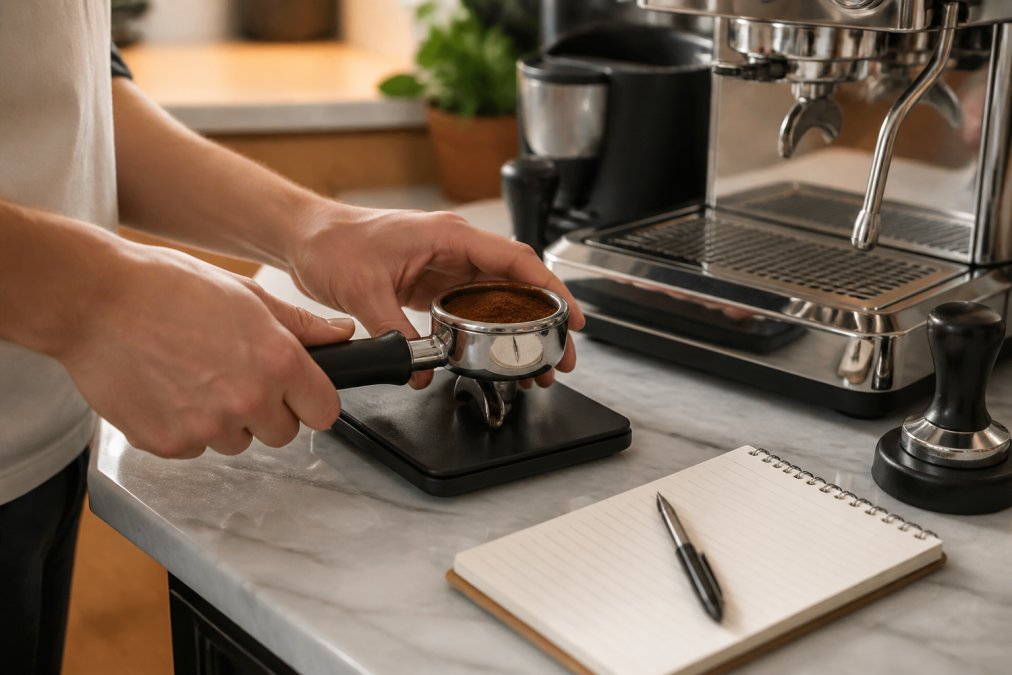
Set your dose to a fixed number and stop changing it. Weigh 18 grams into the basket, level, tamp, then set the grinder to a mid-range espresso setting. From here, the grinder dial is the only thing you adjust for taste.
Step 2: Pull, Weigh, and Taste
Run the shot with a scale under the cup and a timer. Stop the pump at your target yield, not when the machine decides. Record dose, yield, and time, and taste while hot, your palate is the final judge, not the numbers.
Step 3: Adjust One Variable at a Time
If the shot runs fast and tastes sour, grind finer. If it runs slow and tastes bitter, grind coarser. Change nothing else, pull another shot, weigh, taste, record. Single-change shots build your mental map of the grinder.
Step 4: Read the Shot, Not Just the Timer
Time is a clue, not a verdict. A 28-second shot at 1:2 can taste sour if the grind is uneven; a 32-second shot can taste balanced if distribution was clean. Use time to confirm taste, not override it.
Step 5: Know When You Are Done
You are dialed in when three consecutive shots at the same settings taste the same and taste good, not when one shot tastes good. Repeatability is the goal; a lucky shot tells you nothing about tomorrow.
Espresso Extraction Troubleshooting: Sour, Bitter, and Fast or Slow Shots
Espresso extraction troubleshooting comes down to two signals: taste and flow. Sour means under-extracted, water moved too quickly and left sugars behind. Bitter means over-extracted, water pulled too much and dragged harsh compounds along.
| Symptom | Likely Cause | Fix |
|---|---|---|
| Sour, thin, fast shot | Under-extracted | Grind finer |
| Bitter, dry, slow shot | Over-extracted | Grind coarser |
| Sour and bitter together | Channeling | Improve distribution and tamp |
| Gushing, no pressure | Grind far too coarse | Step grind down significantly |
Water Chemistry and Temperature: The Variables Most Home Baristas Skip
Water chemistry and brew temperature shape extraction as much as grind does, yet almost no home guide addresses them. Espresso is roughly 90% water, so your tap directly changes your cup.
Reading Visual and Sensory Cues Beyond Shot Time
Shot time tells you what happened; your eyes and tongue tell you why. Reading the pour and crema gives you information a timer cannot.
- Slow, syrupy pour: likely over-extracted, check for bitterness
- Fast, watery pour: likely under-extracted, check for sourness
- Uneven blonding across the puck: sign of channeling
- Rich, even crema: extraction is in a healthy range
How to Dial In Espresso Shots on Your Specific Machine
Every machine has its own personality, and learning how to dial in espresso shots at home means learning yours. But first you must know which of two very different machines you own, the process is not the same for both.
First, Identify Your Basket Type
This fork in the road is why so many beginners feel the standard advice does not work for them.
Then, Learn Your Machine's Baseline
Once you know your basket type, calibrate against your machine's actual behavior, not its spec sheet.
- Pressure. Most home machines run 9 to 15 bar at the pump; cafes target around 9 bar at the group. If you have an adjustable OPV and a pressure gauge, bring it closer to 9 bar for more forgiving shots. If not, work with what you have.
- Pre-infusion. Some machines wet the puck at low pressure before the main pump engages, reducing channeling and evening out extraction. If yours has it, you can often grind slightly finer.
- Temperature stability. Single-boiler machines swing in temperature between shots; dual boilers and heat exchangers hold steadier. Test: pull three shots in a row with no changes and taste each. If shot three differs from shot one, your machine needs a longer warm-up, most benefit from 15 to 20 minutes, or a cooling flush between shots.
Build a Machine-Specific Rhythm
Once you know your basket type and warm-up behavior, adjustments become predictable. A useful routine:
- Warm up the machine fully before the first shot.
- Pull a blank shot (no coffee) to bring the group head to temperature.
- Pull your first real shot, weigh it, taste it.
- Make one grind adjustment, pull again, taste again.
- Note how many shots it takes to reach a balanced taste. That number is your machine's dial-in cost, and it will shrink as you learn the grinder.
Waste Less While You Dial
Dialing in costs coffee, a typical session uses four to six shots' worth of beans before you land on a setting. That is normal. A few ways to make those grams count:
- Taste every shot, even the bad ones. You learn more from a sour shot you tasted than one you dumped.
- Save drinkable-but-imperfect shots for milk drinks, iced coffee, or an affogato. A sour shot can disappear under milk and sugar.
- Keep rejected shots in the fridge and use them within a day or two for cold brew or baking.
- Buy beans in quantities you will finish within their peak window. Stale beans force a re-dial from scratch, wasting more than any single shot.
Frequently Asked Questions
How do you dial in your espresso shot?
Start with a 1:2 ratio: 18 grams of coffee in, 36 grams of espresso out, in about 25 to 30 seconds. Pull a shot, taste it, and adjust one variable at a time. If it tastes sour, grind finer. If it tastes bitter, grind coarser. Keep your dose steady and log each change so you can repeat the result tomorrow.
What are the signs of an under-extracted espresso shot?
Under-extracted shots taste sharp, sour, and thin, with little sweetness or body. They often run fast, finishing well under 25 seconds, and the flow looks pale and watery. The fix is usually a finer grind or a slightly longer shot time. Adjust in small steps and taste after each change, because overshooting pushes the shot into bitter, over-extracted territory.
How does grind size affect espresso extraction?
Grind size controls how fast water moves through the puck. Finer grinds slow the flow and pull more flavor out of the coffee; coarser grinds speed it up and extract less. A burr grinder gives you the consistent particle size dialing in requires. If your shots swing between sour and bitter with no middle ground, the grinder is usually the limiting factor.
Do I need a scale and timer to dial in espresso at home?
Yes, both matter more than most upgrades. A scale lets you hit your dose and yield in grams, which is the only way to know your brew ratio. A timer tells you how long the shot ran. Without them you are guessing, and guessing makes it hard to repeat a good shot. A basic kitchen scale and your phone timer are enough to start.
Dialing in espresso is a skill you build one shot at a time, and the biggest obstacle is usually stale coffee rather than technique. At Gospel and Grind, we roast to order so your beans arrive fresh, source them carefully, and deliver them straight to your door, all while supporting the fight against homelessness with every cup. Find your perfect roast and give your grinder something worth dialing in.