

Why Drink Freshly Roasted Coffee Beans
Table of Contents
- Why Freshly Roasted Coffee Beans Matter
- Understanding the Coffee Degassing Process
- How Roast Level Affects Your Resting Timeline
- How to Store Coffee Beans for Freshness
- Signs of Stale Coffee Beans
- Brewing Methods and Freshness Requirements
- The Taste Difference: Fresh vs. Aged Coffee
- Conclusion
Last Updated: August 25, 2026
Why Freshly Roasted Coffee Beans Matter
The difference between a cup of coffee brewed from freshly roasted beans and one made from older beans isn't subtle, it's transformative. When you choose freshly roasted coffee beans, you're accessing a window of peak flavor that closes rapidly after roasting. At Gospel and Grind, we've built our entire model around this simple principle: roasting to order ensures maximum freshness arrives at your door, not weeks-old beans from a warehouse shelf.
Most coffee drinkers have no idea how much flavor they're missing. The aromatic compounds that make coffee exceptional, the bright citrus notes, the chocolate undertones, the floral hints, are volatile. They degrade over time. A bean roasted three weeks ago tastes fundamentally different from one roasted three days ago. This isn't theory; it's chemistry. The moment heat leaves the roasting drum, a cascade of chemical reactions begins. Some are desirable. Others are not. Timing matters.
Here's what separates a genuinely great cup from an acceptable one: freshness. Not just "fresh" in a marketing sense, but objectively fresh, beans that still contain the volatile compounds responsible for complexity and depth. When you drink freshly roasted coffee beans, you're tasting what the roaster intended. You're experiencing the full potential of the beans themselves.
Understanding the Coffee Degassing Process
Degassing is the release of carbon dioxide from roasted coffee beans, and it's the primary reason freshness matters so much. When coffee beans are roasted, the heat causes chemical reactions that produce carbon dioxide gas trapped inside the bean's cell structure. After roasting stops, those beans begin releasing that CO2, a process that continues for weeks. This isn't a flaw; it's essential to flavor development.
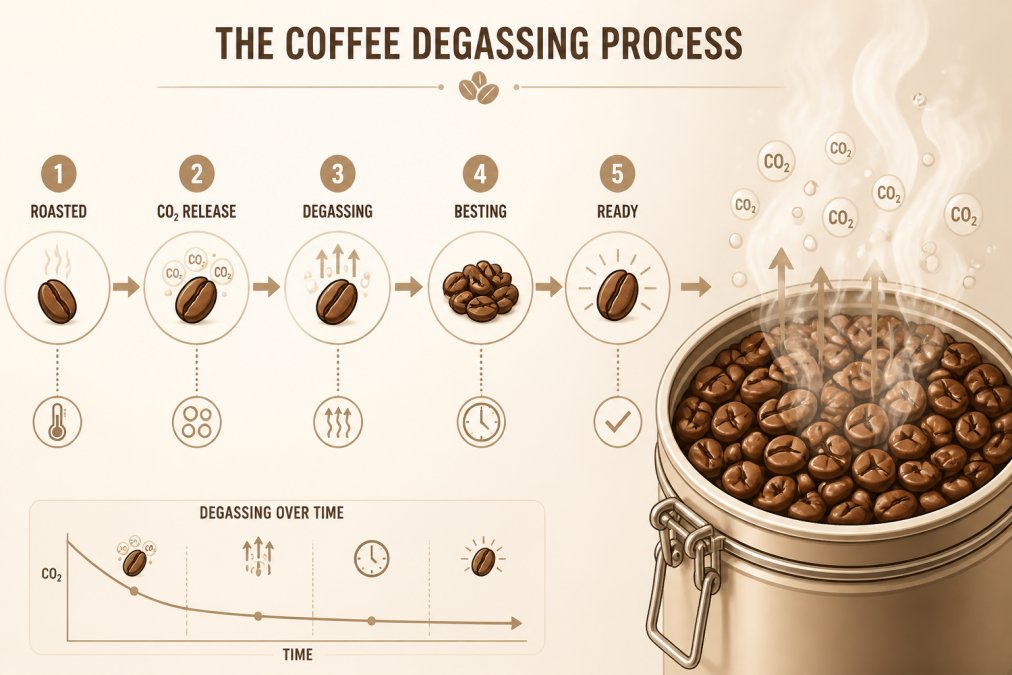
Carbon Dioxide Release and Flavor Development
The relationship between carbon dioxide release and flavor is direct. During the first 24-48 hours after roasting, beans release CO2 rapidly (peer-reviewed research). This aggressive degassing phase affects extraction. If you brew beans too early, within the first 24 hours, the excess CO2 interferes with water's ability to extract flavor compounds evenly. You'll get a sour, under-extracted cup. The CO2 creates a barrier.
But here's where it gets interesting: as degassing slows, volatile aromatic compounds become more stable and accessible. The bean's cell structure, initially disrupted by heat, begins to settle. Flavor clarity improves. The coffee tastes more balanced. This is why a three-day-old bean often tastes better than a one-day-old bean, even though it's older.
The chemistry continues beyond the first week. Enzymatic reactions, processes where proteins and sugars break down, contribute to flavor development for up to 30 days post-roast (peer-reviewed research). After that window, oxidation accelerates. The beans begin to stale. The aromatic profile flattens. You lose the complexity that made the coffee worth buying in the first place.
The Ideal Resting Period for Peak Extraction
The ideal resting period depends on your brewing method and personal preference, but the science is consistent: somewhere between 5 and 30 days post-roast, your beans hit their peak. For espresso, the window is tighter, roughly 9 to 14 days. Espresso extraction is violent and precise. Too much residual CO2 causes channeling (water finding paths of least resistance through the puck). Too little, and the beans have begun to stale.
For immersion methods like French press or cold brew, the timeline is more forgiving. A 14 to 21-day-old bean often performs better than a 5-day-old bean because the degassing is complete and flavor clarity is maximized. The longer contact time of immersion brewing can extract from slightly older beans without the problems that plague espresso.
Pour-over sits in the middle. The ideal range is typically 7 to 21 days. You want enough degassing complete to avoid sourness, but enough aromatic volatility remaining to capture the bean's character.
How Roast Level Affects Your Resting Timeline
Light roasts and dark roasts have different degassing profiles. This matters more than most guides acknowledge. Light roasts have less time in the roaster, so their cell structure is less disrupted. They release CO2 more slowly and over a longer period. A light roast might still be actively degassing at day 10, while a dark roast finished most of its degassing by day 5.
This means the ideal resting period shifts with roast level. A light roast might taste sharp or sour at day 3 but excellent at day 10. A dark roast might be approachable at day 4 but beginning to flatten by day 15. The roast level determines not just the flavor profile but the timeline for peak freshness.
Medium roasts, the most versatile category, typically hit their stride between days 7 and 14. This is why medium roasts are often recommended for beginners. The window is forgiving, and the flavor is balanced across most brewing methods.
Dark roasts are the exception. Because more time in the roaster means more cell structure breakdown, dark roasts degas faster and begin to oxidize sooner. If you're buying dark roast beans, you want them fresher than you might think. A dark roast at day 21 is noticeably staler than a light roast at day 21. The increased surface area and cell damage from extended roasting accelerates oxidation.
How to Store Coffee Beans for Freshness
Once you have freshly roasted coffee beans, storage becomes your second-most important variable. Oxygen, light, heat, and moisture are the enemies. Each one accelerates oxidation and flavor degradation. The goal is to minimize exposure to all four.
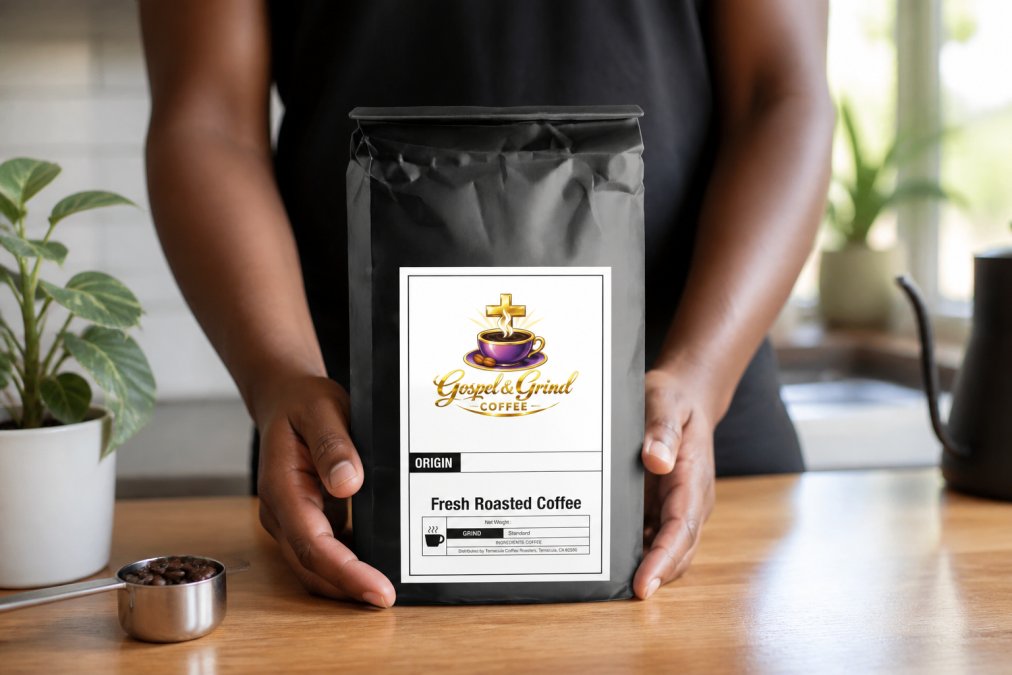
Airtight Containers and Packaging Technology
An airtight container with a one-way valve is the gold standard for storing freshly roasted coffee beans. The one-way valve allows CO2 to escape without letting oxygen back in. This is crucial during the first two weeks post-roast when degassing is still active. A sealed container without a valve would build up pressure and potentially rupture. A container without any seal would expose beans to oxygen immediately.
The best storage containers are opaque or tinted to block light. Glass jars look nice but expose beans to UV radiation, which accelerates oxidation. Opaque ceramic or stainless steel containers are superior. Some people use vacuum-seal bags, which work well for short-term storage but are cumbersome for daily use.
Temperature matters more than most people realize. A cool, dark cupboard is ideal, somewhere between 50-70°F if possible. Never store beans in the refrigerator or freezer. Condensation forms when cold beans warm up, introducing moisture that accelerates staling. Room temperature in a dark cabinet is the right move.
One detail that separates serious coffee drinkers from casual ones: buy only what you'll use in 2-3 weeks. Freshly roasted coffee beans are at their best within this window. After 30 days, the flavor has noticeably declined. Buying in bulk and storing for months defeats the purpose of buying fresh-roasted beans in the first place. Gospel and Grind's roast-to-order model solves this, you receive beans at peak freshness, and the small quantities mean you'll finish them before they stale.
Signs of Stale Coffee Beans
Stale beans don't announce themselves loudly. The degradation is gradual. But once you've tasted truly fresh coffee, the difference becomes obvious. Knowing what to look for helps you avoid buying old stock.
Visual and Sensory Cues for Peak Freshness
Freshly roasted coffee beans should have a matte or slightly oily surface (depending on roast level) and a rich, complex aroma when you open the bag. The smell should be inviting and specific to the bean's origin and roast profile. A bag of fresh beans smells like coffee. A bag of stale beans smells flat, almost cardboard-like.
Visually, fresh beans have a consistent color throughout the batch. Stale beans sometimes show discoloration or a dull appearance. This isn't always obvious, but once you've handled fresh beans regularly, you notice it. The difference is subtle but real.
The most reliable test is the bloom test during brewing. When you pour hot water over freshly roasted coffee grounds, they should bloom dramatically, rising and releasing visible CO2 bubbles. Stale grounds bloom weakly or not at all. This visual cue tells you immediately whether your beans have retained their vitality.
Taste is the final arbiter. Fresh beans taste bright, complex, and balanced. Stale beans taste flat, dull, and one-dimensional. If your coffee tastes like it's missing something, like it lacks the vibrancy you expect, your beans are probably past their peak. This is especially noticeable in pour-over or filter methods, where flavor clarity is paramount.
Brewing Methods and Freshness Requirements
Different brewing methods extract flavor differently, which means they have different freshness requirements. This is a detail most casual coffee drinkers never consider, but it explains why the same beans can taste excellent in one brew method and mediocre in another.
Espresso is the most sensitive to freshness timing. The high pressure and rapid extraction mean that beans need to be in a specific degassing window. Too fresh, and the CO2 interferes with extraction. Too old, and the flavor is thin. This is why espresso enthusiasts obsess over roast dates. A nine-to-fourteen-day window is ideal for most espresso applications.
French press is the most forgiving. The long contact time (typically 4 minutes) means that even older beans can be fully extracted. The immersion method doesn't rely on pressure or precise timing. A fourteen-to-thirty-day-old bean often performs better in French press than a five-day-old bean because the degassing is complete and flavor clarity is maximum.
Pour-over methods sit in the middle. They require some degassing to be complete (to avoid sourness) but benefit from beans that still have aromatic volatility. A seven-to-twenty-one-day window works well. The precise pour-over technique also means that fresher beans, with their more active degassing, can sometimes cause over-extraction if you're not careful with your technique.
Cold brew is unique. The long steeping time (12-24 hours) and low temperature mean that cold brew can extract from older beans effectively. Some cold brew enthusiasts prefer beans that are 21-30 days old because the reduced aromatic volatility doesn't matter in cold brew's muted flavor profile. Cold extraction is gentler and less likely to pull out harsh compounds from older beans.
The Taste Difference: Fresh vs. Aged Coffee
If you've never done a direct comparison, you're missing one of the most illuminating coffee experiments. Brew the same beans at day 5 post-roast and day 25 post-roast using the same method, same ratio, same technique. The difference is stark.
At day 5, the coffee is often bright and complex but can have a slight sourness, a sharpness that some people mistake for acidity. The aromatic profile is bold. You taste the origin clearly. At day 25, that sourness is gone, the flavor is rounder and more balanced, but something is missing. The complexity has flattened. The coffee tastes good, but not remarkable.
This is oxidation in action. The volatile aromatic compounds that create complexity have degraded. What remains is a simpler, less interesting cup. For specialty coffee, this difference is the entire point. You're paying for those aromatic compounds, for the complexity, for the specific flavor notes that a particular origin and roast level can deliver. Stale beans deliver a fraction of that promise.
This is why Gospel and Grind's roast-to-order model matters. You're not buying beans that were roasted weeks ago and shipped through distribution channels. You're getting beans roasted specifically for your order, shipped within days. You're tasting coffee at its peak potential, not its decline.
Frequently Asked Questions
How long should you wait to drink freshly roasted coffee beans?
Most freshly roasted coffee beans reach peak flavor 3 to 10 days after roasting, depending on roast level and brewing method. Light roasts typically peak around 5 to 7 days, while medium and dark roasts may benefit from 7 to 10 days of resting. This allows carbon dioxide to escape and volatile compounds to stabilize. Espresso extraction often requires a shorter window of 5 to 7 days due to the high pressure involved. Waiting too long, beyond 3 to 4 weeks, causes oxidation and flavor degradation.
What is the 15-15-15 rule for coffee?
The 15-15-15 rule is a guideline suggesting that coffee reaches ideal flavor at 15 days after roasting, should be consumed within 15 days of opening, and tastes best when brewed within 15 minutes of grinding. While this is a helpful starting point, the actual peak freshness window varies based on roast level, storage conditions, and your brewing method. Roasted-to-order beans from sources like Gospel and Grind arrive at your door within days of roasting, ensuring you capture the full aromatic profile and flavor clarity before oxidation sets in.
How does oxidation affect the flavor of coffee beans?
Oxidation occurs when oxygen interacts with the oils and compounds in roasted beans, gradually breaking down the volatile aromatics that create bright acidity and complex flavor notes. Over time, oxidized coffee loses its vibrant taste and develops flat, stale characteristics. Proper storage in airtight containers with one-way valves slows oxidation significantly. Freshly roasted beans have the highest concentration of these aromatic compounds, which is why they deliver richer body, cleaner extraction, and more pronounced flavor notes compared to beans that have oxidized over weeks or months.
Are freshly roasted coffee beans better than pre-roasted grocery store coffee?
Yes. Freshly roasted beans retain volatile compounds, oils, and aromatic profiles that degrade quickly after roasting. Grocery store coffee is often roasted weeks or months before purchase, meaning much of the flavor complexity has already oxidized. Freshly roasted coffee delivers noticeably brighter acidity, cleaner extraction, richer body, and more distinct flavor notes. Roast-to-order services ensure beans are roasted just days before arrival, maximizing the window for peak flavor. The difference is most apparent in espresso extraction and pour-over brewing, where freshness directly impacts crema formation and bloom quality.
The real reason to drink freshly roasted coffee beans is simple: flavor. Everything else, the origin story, the farming practices, the roast profile, only matters if the beans are fresh enough to express it. Stale beans waste the farmer's work, the roaster's skill, and your money. Find your perfect roast with Gospel and Grind, where every batch is roasted to order and delivered fresh. Taste the difference that freshness makes.
This article was written using GrandRanker