

What Is the 15-15-15 Rule for Coffee? A Freshness Guide
Table of Contents
- What Is the 15-15-15 Rule for Coffee?
- The 15 Months: Green Coffee Bean Shelf Life
- The 15 Days: Peak Flavor After the Roast Date
- The 15 Minutes: Why Ground Coffee Loses Its Edge
- The Coffee Degassing Process and Why It Matters
- How to Store Coffee Beans for Freshness
- How Roast Level Changes the 15-Day Rule
- Frequently Asked Questions
Last Updated: September 24, 2026
What Is the 15-15-15 Rule for Coffee?
What is the 15-15-15 rule for coffee? It's a freshness framework that assigns a distinct window to each stage of a bean's life: 15 months for green coffee, 15 days for roasted whole beans, and 15 minutes for ground coffee before flavor fades. This guide from Gospel and Grind breaks down what each number means and how to use it to brew a better cup.
The rule isn't a countdown clock you can ignore. It's a set of deadlines, and every one is set by oxygen. Once you understand that, storage becomes the single biggest lever on cup quality.
The Three 15s Explained
Each 15 in the rule marks a different shelf life, and each one is dramatically shorter than the last.
- 15 months: Green, unroasted coffee beans keep their character for roughly 15 months when stored properly.
- 15 days: Once roasted, whole beans hold peak flavor for about 15 days after the roast date.
- 15 minutes: After grinding, coffee begins losing its most fragile aromatics within 15 minutes.
The pattern is simple: the more processed the bean, the faster it fades. Roasting cracks the bean open and drives off moisture; grinding multiplies the exposed surface area. Each step hands oxygen more places to attack.
That's why a bag with no roast date tells you almost nothing useful. The 15-15-15 rule only works if you know when the clock started.
The 15 Months: Green Coffee Bean Shelf Life
Unroasted green coffee beans stay viable for about 15 months, which is why roasters buy in harvest cycles rather than keeping years of stock.
Green beans are dense and low in moisture, so they resist oxidation far better than roasted beans. But they aren't inert: they absorb odors, lose moisture, and slowly degrade. Store them cool, dry, dark, and away from anything strongly scented.
Green coffee is a living agricultural product, not a shelf-stable commodity. Beans from a fresh harvest taste different from beans that have sat in a warehouse for two years, even if both are technically "within spec."
This is why roast-to-order matters: roasting in small batches against actual demand turns green stock over faster and gets roasted coffee to you closer to its peak. That's the model Gospel and Grind runs on.
The 15 Days: Peak Flavor After the Roast Date
Roasted whole beans hit peak flavor roughly 15 days after roasting, which is why the roast date matters far more than any printed "best by" date.
Most grocery bags carry a best-by date months in the future, that tells you when coffee becomes unacceptable, not when it tastes best. A roast date tells you when the clock started.
After roasting, beans lose carbon dioxide and volatile aromatic compounds. The first few days are dominated by heavy degassing, which is why very fresh beans can taste flat or sharp. Days four through fifteen are typically the sweet spot: enough degassing for stable extraction, enough aromatics for a complex cup.
"15 days" is a peak window, not a cliff. Beans don't spoil on day sixteen; they start a gradual decline in aroma and acidity. A well-stored 30-day-old bean often beats a poorly stored 10-day-old one.
The 15 Minutes: Why Ground Coffee Loses Its Edge
Ground coffee begins losing its most delicate aromatics within about 15 minutes of grinding, which is why pre-ground never matches freshly ground coffee from the same bean.
The mechanism is surface area. A whole roasted bean exposes only its outer skin to air; grinding it into a typical drip grind shatters it into hundreds of fragments, multiplying exposed surface area by a factor most roasters put in the hundreds.
Does the 15-minute rule apply to cold brew?
The 15-minute rule is about aroma loss, not extraction, so it applies to cold brew too, but the practical impact is smaller.
The practical rule
Grind immediately before brewing. If you can't, grind only what you'll use within a day and store it airtight, away from light and heat. For espresso this is non-negotiable, the fine grind means the clock starts the moment the burrs stop. For drip and pour-over you have a few minutes of grace; for cold brew, a few hours.
The Coffee Degassing Process and Why It Matters
The coffee degassing process is the release of carbon dioxide trapped inside beans during roasting, and it drives both the 15-day and 15-minute rules.

How to Store Coffee Beans for Freshness
Storing coffee beans well comes down to four variables: oxygen, light, heat, and moisture. Control those and you extend the 15-day window considerably. The useful part is knowing how much each storage method actually buys you.
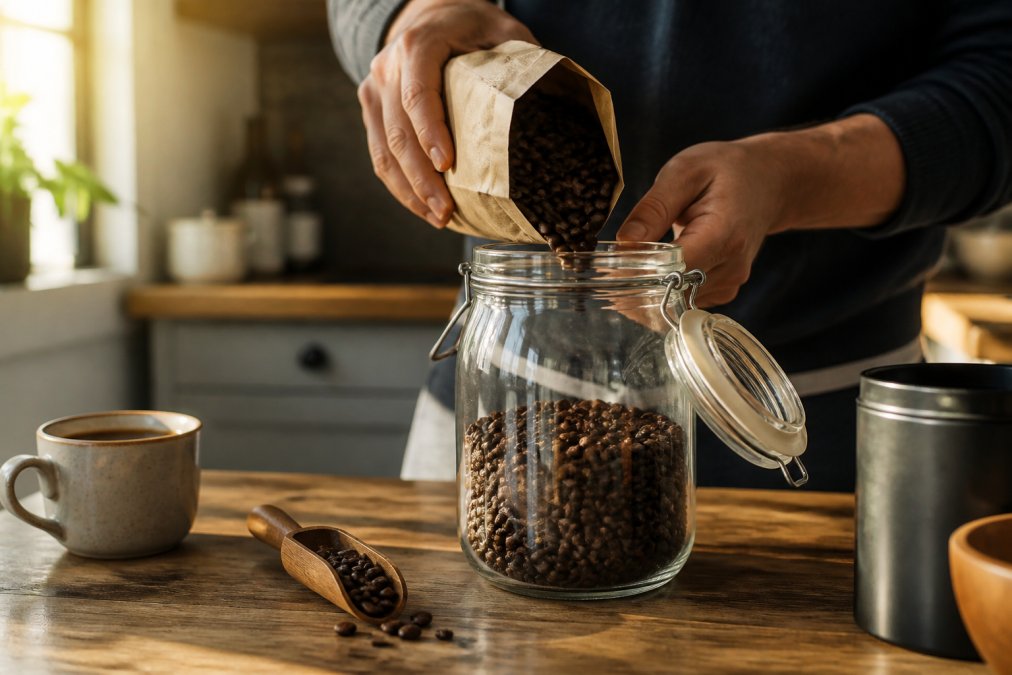
How much time does each container actually buy you?
The numbers below reflect the general experience of home brewers and roasters comparing the same roast stored four ways; treat them as directional, not lab-precise.
| Storage Method | Approximate Peak Window | Main Trade-Off |
|---|---|---|
| Original valve bag, clipped shut | 10-14 days | Not fully airtight once opened; bag can't be resealed perfectly |
| Airtight glass jar, opaque | 14-21 days | Light exposure unless opaque; glass can transmit temperature swings |
| Vacuum-sealed container | 21-30 days | Cost and counter space; some models need replacing gaskets |
| Freezer, portioned and sealed | 2-3 months at near-peak | Requires thawing discipline; repeated freeze-thaw cycles degrade beans |
The freezer protocol that actually works
Freezing is where most people go wrong, and the mistake is usually portioning. Freeze beans in single-use portions, enough for one or two brews, sealed as tightly as possible. Every time you open the container and pull out a scoop, warm, moist air condenses on the remaining cold beans. Repeated freeze-thaw cycles are worse than leaving beans at room temperature.
What to do with beans past the 15-day mark
Once a bag has clearly faded, flat aroma, muted acidity, a cardboard note in the cup, you have options short of the trash.
- Cold brew. The 12-to-24-hour cold steep extracts the heavier, more stable compounds that survive oxidation better than the bright acids. Stale beans make noticeably better cold brew than they do pour-over.
- Baking. Ground stale coffee works as a flavoring in brownies, spice rubs, and marinades, where the coffee's bitterness and roast notes are supporting players rather than the star.
- Compost. Spent grounds and stale beans both break down well in compost, adding nitrogen to the pile.
- Refrigerator deodorizer. A small bowl of dry, stale grounds absorbs odors in the fridge the same way baking soda does. Replace monthly.
The buying rule that matters most
No storage method beats buying the right quantity. If you drink one cup a day, a 12-ounce bag lasts roughly two to three weeks at a typical 18-gram dose, right at the edge of the 15-day window. A two-pound bag is a losing proposition unless you freeze most of it on arrival. Buy what you'll finish within two to three weeks, and let the roaster's roast date, not the grocery store's best-by date, tell you when the clock started.
How Roast Level Changes the 15-Day Rule
Roast level shifts the 15-day window in both directions, and ignoring it is one of the most common storage mistakes.
Frequently Asked Questions
What is the 15-15-15 rule for coffee?
The 15-15-15 rule is a freshness guideline: green coffee beans stay good for 15 months, roasted beans peak within 15 days of the roast date, and ground coffee loses its best flavor within 15 minutes. It's a simple way to remember how time and oxygen affect each stage of coffee.
How long do roasted coffee beans stay fresh?
Roasted beans are generally at their best for 15 to 30 days after the roast date. After that, oxidation and moisture exposure gradually flatten the aroma and flavor. Storing them in an airtight container away from light and heat can stretch that window. Beans roasted to order, like those from Gospel and Grind, arrive closer to their peak.
What is the best way to store coffee beans to maintain flavor?
Keep beans in an airtight, opaque container at room temperature, away from light, heat, and moisture. Skip the fridge for daily use because condensation can harm the beans. For longer storage, freezing in a sealed bag works well. Buy only what you'll use within a few weeks so every cup tastes fresh.
Why is degassing important for freshly roasted coffee?
After roasting, beans release carbon dioxide in a process called degassing. This off-gassing protects flavor during the first few days but also makes brewing tricky because the gas repels water. Waiting 3 to 7 days after the roast date lets beans settle into their ideal brewing window, so extraction is even and flavor notes come through clearly.
Does coffee flavor peak after roasting?
Yes. Most roasted coffee reaches peak flavor between 4 and 14 days after the roast date, once degassing slows and the beans are stable enough to extract evenly. After about 15 days, volatile compounds fade and the cup tastes flatter. Buying from a roaster that ships soon after roasting keeps you inside that window.
How does oxygen affect coffee bean freshness?
Oxygen is the main enemy of coffee freshness. It reacts with oils and volatile compounds on the bean surface, causing oxidation that dulls aroma and creates stale, cardboard-like notes. Limiting oxygen exposure with airtight containers, one-way valve bags, or vacuum sealing slows that decline and keeps the flavor closer to peak.