

Why Coffee Beans Lose Flavor After Roasting
Table of Contents
- The Chemistry Behind Why Coffee Beans Lose Flavor After Roasting
- How to Store Coffee Beans for Maximum Freshness
- Coffee Bean Shelf Life After Roasting: A Realistic Timeline
- Signs of Stale Coffee Beans You Should Never Ignore
- Bean Density, Roast Level, and How Long Flavor Actually Lasts
- Why Roast-to-Order Coffee Keeps Its Flavor Longer
- Frequently Asked Questions
Last Updated: September 21, 2026
The Chemistry Behind Why Coffee Beans Lose Flavor After Roasting
Roasted coffee is a perishable product, and the same chemistry that creates its flavor begins dismantling it within days. At Gospel and Grind, we roast to order precisely because the clock starts ticking the moment beans leave the roaster. Below, we break down what actually happens inside the bean, not just that oxidation occurs, but which molecules are doing the work and why some disappear faster than others.
Oxidation and Volatile Aromatic Compounds
Oxidation is the reaction between oxygen in the air and the oils inside roasted coffee, and it is the primary reason coffee beans lose flavor over time. Roughly 800 aromatic compounds have been identified in roasted coffee, and they are volatile by nature: they evaporate, react, and degrade continuously once exposed to air.
-
Pyrazines carry the nutty, roasted, earthy notes in the aroma. They form during the Maillard reaction and are relatively stable, which is why a stale bean often still smells vaguely 'like coffee' even after the good stuff is gone.
-
Aldehydes are responsible for many of the fruity, floral, and citrus top notes, the ones that make a washed Ethiopian smell like jasmine or a Kenyan like blackcurrant. Aldehydes are highly reactive and are among the first compounds to oxidize, which is why bright, delicate coffees lose their sparkle before they lose their body.
-
Furans contribute caramel and sweet, toasted notes. They sit in the middle of the stability range.
-
Ketones and esters round out fruity and buttery characteristics and degrade at varying rates depending on the specific molecule.
-
Hydrolysis, moisture in the air reacts with oils and acids in the bean, producing the sour, rancid notes that signal genuinely spoiled coffee rather than merely faded coffee.
-
Photo-oxidation, light, particularly UV, provides energy that speeds up the oxidation of sensitive compounds. This is why clear glass jars on a sunny counter are the worst possible storage choice, even if they look nice.
Degassing, Carbon Dioxide, and the Resting Window
Freshly roasted beans release carbon dioxide for days after roasting, a process called degassing (pubmed.ncbi.nlm.nih.gov). This matters for two reasons. First, CO2 escaping from the bean pushes oxygen out, briefly protecting the coffee from oxidation. Second, too much gas interferes with brewing: beans roasted yesterday can produce an uneven, foamy extraction because trapped CO2 repels water. This creates a short resting period, typically a few days, when coffee is best brewed rather than stored.
- Resting is a development phase. CO2 is still venting, and the flavors inside the bean are still integrating. A coffee brewed too soon after roast can taste sharp, gassy, or hollow. Give it a few days and the same bean tastes sweeter and more coherent. Flavor is improving.
- Staling is a decline phase. The protective CO2 blanket is gone, oxygen has full access to the oils, and the volatile aromatics begin breaking down. Flavor is degrading, and it does not come back.
How to Store Coffee Beans for Maximum Freshness
The goal is simple: keep oxygen, moisture, heat, and light away from the beans. Four variables, four enemies. Here is how to store coffee beans for maximum freshness without overcomplicating your kitchen routine.
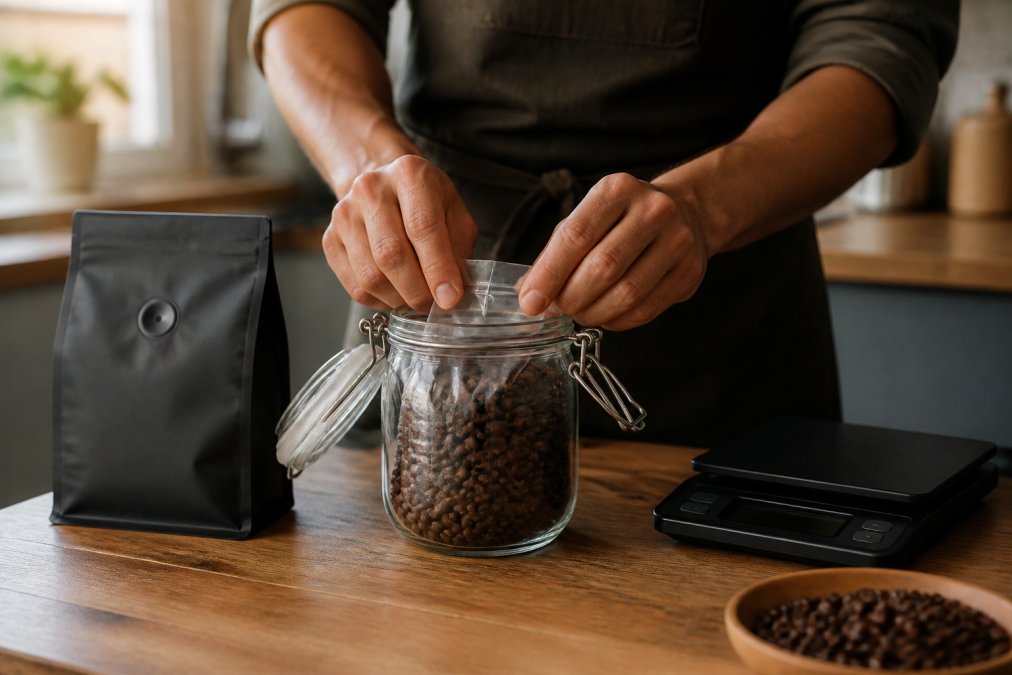
Airtight Containers, One-Way Valves, and Vacuum Seals
An airtight container is the single highest-impact purchase you can make. The best options are opaque, block UV light exposure, and fit in a cool cupboard. A one-way valve lets CO2 escape without letting oxygen in, which is why good roasters package in valve-equipped bags. Vacuum sealing removes oxygen almost entirely and works well for beans you will not touch for a week or more.
Freezing Coffee Beans: When It Works and When It Backfires
Freezing is the most misunderstood preservation method in coffee. Done right, it slows oxidation and thermal degradation for weeks or months. Done wrong, it ruins beans fast. The rules:
- Freeze only whole beans, never pre-ground
- Use an airtight, vacuum-sealed container with minimal headspace
- Portion into single-use amounts before freezing
- Never thaw and refreeze; condensation destroys cell structure
- Grind frozen beans directly, without thawing, for best results
Coffee Bean Shelf Life After Roasting: A Realistic Timeline
Coffee bean shelf life after roasting depends on packaging, roast level, and storage, but a general timeline holds true. Peak flavor arrives a few days post-roast and begins declining steadily after that.
| Time After Roast | Flavor State | Best Use |
|---|---|---|
| 1-3 days | Resting; heavy degassing | Wait if possible |
| 4-14 days | Peak flavor and aroma | Brew and enjoy |
| 2-4 weeks | Still good, slowly flattening | Daily brewing |
| 1-3 months | Noticeably stale | Cold brew, milk drinks |
| 3+ months | Flat and papery | Compost |
Signs of Stale Coffee Beans You Should Never Ignore
Stale beans announce themselves before you brew. The clearest signs of stale coffee beans are a dull, matte surface instead of an oily sheen, a weak or absent aroma when you open the bag, and beans that feel lightweight and brittle rather than dense. If you press a bean and it crumbles instead of snapping, oxidation has done its work.
Bean Density, Roast Level, and How Long Flavor Actually Lasts
Most storage advice treats 'coffee beans' as a single material. They are not. Two beans of the same origin, roasted to different levels, will stale at meaningfully different rates, and the reason comes down to physical structure, not just chemistry.
Why Roast Level Changes the Clock
Green coffee is dense and structurally intact. As it roasts, heat and internal steam pressure expand the bean's cell walls, creating millions of microscopic pores. The darker the roast, the more those cell walls break down and the more porous the bean becomes. That porosity cuts both ways:
- More surface area means more exposure. A porous bean has more internal surface for oxygen to contact, so oxidation reaches deeper into the bean faster.
- Oils migrate outward. As roast development continues, the oils that were sealed inside the cell structure are pushed to the surface. Surface oil is directly exposed to oxygen, light, and air movement. Oil locked inside an intact cell is far better protected.
- Darker roasts start with less to lose. Many of the delicate aldehydes and fruity esters that define a light roast are already destroyed by the longer, hotter roast that produces a dark profile. A dark roast begins its life with a simpler, more stable aromatic profile, so it has fewer fragile compounds to lose, but the compounds it does have (surface oils) are the most exposed.
Bean Density and Origin
Density is largely set before roasting. High-grown beans from higher altitudes develop more slowly and more densely, with tighter cell structures and more concentrated sugars and acids. Denser beans generally correlate with more complexity and slightly slower staling, because there is more intact structure for oxygen to work through. Lower-grown, less dense beans have looser cell structures and tend to fade faster.
Putting It Together: A Practical Freshness Window
Combining roast level and density gives a rough sense of how long a coffee stays at its best. These are patterns, not guarantees, packaging and storage matter as much as the bean itself:
- Light roast, high-grown single origin: brightest window, but the shortest peak. Expect the distinctive top notes to fade within two to three weeks of roast even with good storage.
- Medium roast, dense bean: the sweet spot for storage. Peak flavor often holds for three to four weeks in an airtight container, with a slower decline after that.
- Dark roast, oily surface: drink it fresh. Surface oils begin oxidizing within days of roast, and the flavor flattens noticeably within two to three weeks.
- Dark roast espresso blends: often formulated for consistency rather than peak nuance, so they tolerate a slightly longer window, but the crema and the sweet, syrupy body fade first.
Why Roast-to-Order Coffee Keeps Its Flavor Longer
The most effective preservation method is buying coffee that has not spent weeks in transit and on a shelf. Roast-to-order means the coffee is roasted after you order, not before, so it reaches you inside the resting-to-peak window rather than at the tail end of its shelf life. Gospel and Grind roasts every batch to order and ships directly to your door, which is why our customers routinely describe the difference as obvious on the first cup.
Frequently Asked Questions
How long should you let coffee beans rest after roasting?
Most roasters recommend waiting 3 to 7 days after the roast date before brewing, though this varies by roast level. Darker roasts degas faster and are often ready in 2 to 4 days, while lighter roasts may need 7 to 10 days for peak flavor. The resting period lets carbon dioxide escape so water can extract solubles evenly during brewing. If your coffee tastes flat or foams excessively, it likely needs more rest.
Does freezing coffee beans actually preserve their flavor?
Freezing can slow oxidation and preserve volatile oils, but only when done correctly. Store beans in an airtight, vacuum-sealed container with minimal headspace and avoid repeated thawing, which introduces moisture and causes thermal degradation. Single-dose portions work best. For daily brewing, keeping beans at room temperature in an opaque, airtight container is simpler and avoids the risk of condensation damaging cell structure.
What are the signs of stale coffee beans?
Stale beans lose their aroma first, then their flavor. Look for beans that smell flat, papery, or like cardboard instead of sweet and fragrant. Brewed coffee may taste bitter, hollow, or lacking acidity and notes. Visually, stale beans can appear dull or oily from oxidation. If your cup tastes lifeless even with a good grind and ratio, the beans are likely past their shelf life.
Why does coffee lose its aroma before it loses its flavor?
Volatile aromatic compounds are lighter and more reactive than the heavier solubles that carry flavor. These compounds oxidize quickly when exposed to oxygen, light, and heat, which is why the smell fades first. Flavor compounds like acids and sugars degrade more slowly. This is why coffee can still taste acceptable but smell disappointing. Storing beans in an airtight container away from UV light exposure helps preserve those aromatic compounds longer.
Coffee beans lose flavor after roasting because of chemistry you cannot outrun, only slow down. Oxidation, moisture, heat, and light will win eventually, but the right storage and a fresh roast date buy you weeks of genuinely excellent cups. Gospel and Grind roasts to order for maximum flavor and aroma, delivers directly to your door, and supports the fight against homelessness with every purchase. Find your perfect roast and taste what fresh actually means.