

Impact of Oxygen Exposure on Coffee Bean Flavor
Table of Contents
- How Oxygen Exposure Changes Coffee Bean Flavor
- Signs of Stale Coffee Beans
- Coffee Shelf Life After Roasting
- The Role of CO2 Degassing vs. Oxygen Ingress
- Best Coffee Storage Containers and Packaging Solutions
- How Grinding Accelerates Oxidation
- Sensory Evaluation: Tasting Oxidized Coffee
- Frequently Asked Questions
Last Updated: September 18, 2026
How Oxygen Exposure Changes Coffee Bean Flavor
The impact of oxygen exposure on coffee bean flavor begins the moment a roasted bean meets air. Oxygen drives oxidation, the same chemical reaction that turns a sliced apple brown, and it attacks the compounds that make coffee taste vibrant and sweet. At Gospel and Grind, we roast to order because that clock starts ticking the day beans leave the roaster. Below, we break down what actually happens at the molecular level, how to spot the damage, and how to slow it down.
The Chemistry of Coffee Oxidation
Oxidation is the reaction between oxygen molecules and the organic compounds inside a roasted bean, and it is the single largest driver of flavor loss after roasting. Once a bean is roasted, its cell structure fractures and its oils migrate to the surface, where they sit directly in the path of airborne oxygen.
The reaction accelerates with heat, light, and moisture. Each one raises the energy available to the molecules, so a warm, bright kitchen counter is the worst possible home for a bag of beans.
How Oxygen Affects Aromatic Compounds and Coffee Oils
Aromatic compounds are the volatile molecules responsible for everything you smell when you open a fresh bag, and they are the first casualties of oxygen exposure. These compounds are fragile by design; they evaporate readily, which is exactly why you can smell them at all.
Coffee oils suffer a slower, uglier fate. The lipids in coffee undergo lipid oxidation, a process that produces rancidity. That stale, cardboard-like note in old coffee is not a lack of flavor; it is a new flavor, and not a good one. Where fresh coffee reads as bright and clear, oxidized coffee turns dull, flat, and muted, losing intensity and flavor clarity.
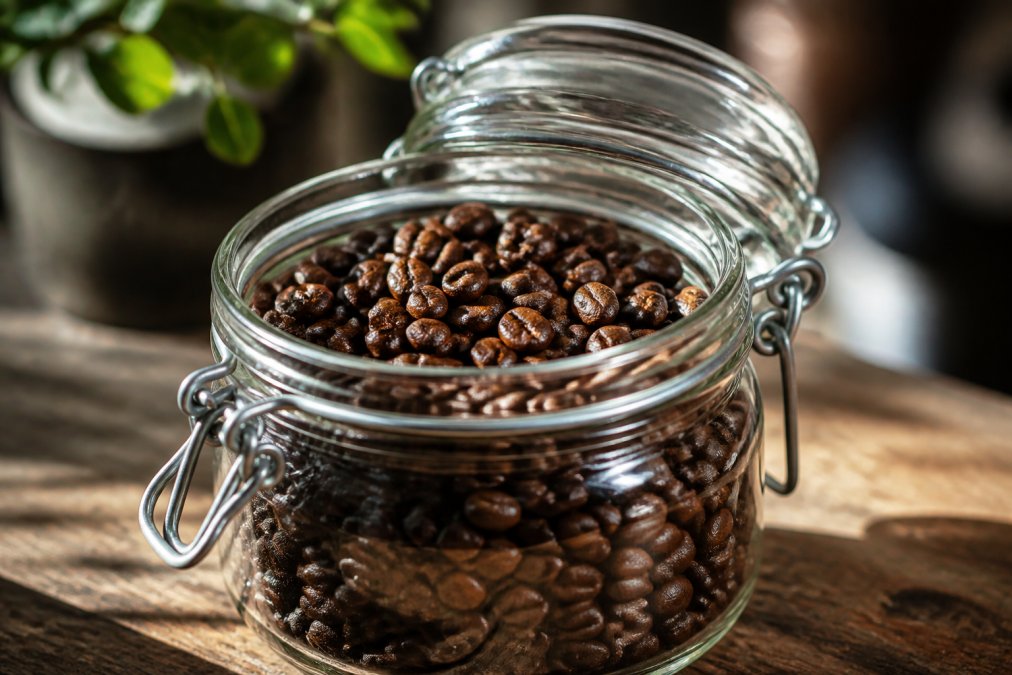
Signs of Stale Coffee Beans
You can identify stale coffee beans by four reliable signals: a flattened aroma, surface oiliness, a muted or papery taste, and beans that no longer bloom when hot water hits them. Trust your nose first. Fresh beans announce themselves from across the room.
Here is what to check:
- Aroma: Fresh beans smell sweet, fruity, or chocolaty. Stale beans smell like cardboard or wet paper.
- Surface: A light sheen is normal on darker roasts. Heavy grease means the oils have fully migrated and oxidation is well underway.
- Taste: If the cup tastes flat or bitter without sweetness, the aromatic compounds are gone.
- Bloom: Fresh coffee puffs up when you pour hot water over it. No bloom means the carbon dioxide is gone.
Coffee Shelf Life After Roasting
Coffee shelf life after roasting is roughly two to four weeks for peak flavor when beans are stored whole in an airtight container, though beans remain drinkable for several months with declining quality. The drop is not linear. Most of the aromatic loss happens in the first two weeks.
A common approach is to buy in smaller quantities more often.
Green Coffee vs. Roasted Coffee Oxidation
Green coffee resists oxidation far better than roasted coffee because its cell structure is intact and its oils remain locked inside the bean. Unroasted green coffee can hold quality for many months, sometimes longer, when kept dry and cool.
The Role of CO2 Degassing vs. Oxygen Ingress
Roasted coffee releases carbon dioxide for days after roasting, and that degassing process actually protects the beans by pushing oxygen out of the container. This is why roasters use a one-way valve on bags: it lets CO2 escape without letting air in.
The Degassing Timeline
Most of the CO2 trapped in a roasted bean escapes in the first 24 to 72 hours after roasting. The rate then tapers off over the following one to two weeks. A useful mental model:
- Days 0-3: Heavy degassing. The bag may visibly puff. Oxygen is being actively pushed out.
- Days 3-7: Moderate degassing. Positive pressure is fading but still present.
- Days 7-14: Minimal degassing. The bean is now a passive target for whatever oxygen reaches it.
- After 14 days: Essentially no protective outgassing. Oxidation is now the dominant reaction.
The Counterintuitive Trap: Sealing Too Early
A vacuum-sealed bag is not automatically better than a valve bag. If you vacuum-seal beans within the first day or two of roasting, you trap CO2 that will continue to escape. As it escapes, it creates an internal vacuum that pulls the bag tight against the beans, and any microscopic weak point in the seal becomes an entry path for oxygen.
What This Means for Storage Decisions
- If you buy within a few days of roast: Leave the beans in the original valve bag, squeeze out excess air gently, and reseal. The valve is doing useful work.
- If you buy beans that are already two weeks past roast: The valve has done its job. Transfer to a truly airtight container, because there is no more CO2 pressure to protect the beans.
- If you freeze: Freeze in the original valve bag or a vacuum bag, but only after the initial degassing window has passed. Freezing during heavy degassing traps CO2 that will expand and stress the seal.
If you are unsure whether a bag is still degassing, squeeze it gently. A bag that resists compression and slowly re-inflates is still releasing CO2. A bag that stays compressed has finished degassing and is now vulnerable to oxygen ingress.
Best Coffee Storage Containers and Packaging Solutions
The best coffee storage containers are opaque, airtight, and sized to hold only as much coffee as you will drink in about two weeks. Beyond that, you are storing air as much as beans.
What actually works:
- Airtight ceramic or stainless steel canisters with a gasket seal block both oxygen and light.
- Original valve bags, rolled down and clipped, work well for short-term storage.
- Vacuum containers remove oxygen but must be resealed every time you open them.
- Single-serve capsules solve the problem entirely by sealing each dose with no oxygen inside.
Oxygen Transmission Rates (OTR) of Packaging Materials
Oxygen transmission rate, or OTR, measures how much oxygen passes through a given area of packaging material over a set period. It is the number most coffee drinkers never see, and it explains why two bags that both say "airtight" perform very differently.
| Packaging Material | Relative OTR | Best For |
|---|---|---|
| Foil-lined multiwall bag | Very low | Whole bean, long transit |
| Metallized PET pouch | Low | Retail whole bean |
| Clear PET jar | High | Short-term display only |
| Paper bag, unlined | Very high | Immediate use only |
| Sealed capsule | Effectively zero | Single servings |
If you transfer beans out of the original bag, keep the bag. Pour the beans back into the foil pouch and squeeze out excess air before resealing. Foil outperforms most decorative canisters on OTR, and it already has the valve.
How Grinding Accelerates Oxidation
Grinding accelerates oxidation dramatically because it multiplies the surface area exposed to oxygen. A whole bean exposes a small outer shell. A ground particle exposes its entire interior, and there may be hundreds of particles in a single dose.
Sensory Evaluation: Tasting Oxidized Coffee
You can taste oxidation directly if you set up a simple side-by-side comparison. Brew two cups from the same roast, one from a freshly opened bag and one from beans left out overnight, and taste them blind.
What to look for:
- Aroma: Fresh coffee hits you before you sip. Oxidized coffee barely registers.
- Acidity: Fresh coffee has a bright, lively edge. Oxidized coffee tastes flat.
- Sweetness: Oxidation strips the sugars that balance bitterness.
- Finish: Fresh coffee lingers pleasantly. Oxidized coffee fades fast or turns papery.
Frequently Asked Questions
How quickly does oxygen exposure degrade coffee flavor?
Coffee beans begin losing peak flavor within 7 to 14 days after roasting when exposed to oxygen. Ground coffee oxidizes much faster, often within hours. Whole beans stored in an airtight container with minimal oxygen exposure can maintain good flavor for up to 4 weeks, though the most vibrant aromatic compounds fade within the first week.
What are the signs of stale coffee beans?
Signs of stale coffee beans include a dull, flat aroma with no distinct origin notes, a muted or cardboard-like taste, and beans that appear dry with no surface oils. Fresh beans smell sweet and complex. If your coffee tastes bitter without any brightness or sweetness, oxidation has likely degraded the aromatic compounds and coffee oils.
What is the best way to store coffee beans to minimize oxygen exposure?
Store whole beans in an opaque, airtight container with a one-way valve to release CO2 while blocking oxygen. Keep the container in a cool, dark place away from heat and moisture. For longer storage, vacuum sealing or freezing in single-use portions works well. Avoid clear containers and never store beans in the refrigerator, where moisture and odors penetrate.
Does storing coffee in the freezer prevent oxidation?
Freezing slows oxidation but does not stop it entirely. For best results, freeze freshly roasted whole beans in an airtight, vacuum-sealed bag and use them directly from frozen without thawing. Repeatedly opening and closing a freezer container introduces moisture and oxygen, accelerating flavor degradation. Portion beans into single-use bags before freezing.
Coffee's enemies are patient, and oxygen is the most patient of all. It does not care how good the beans were on roast day; it only needs time and access. Gospel and Grind roasts to order so your beans spend less time in the danger zone, seals single-serve capsules with no oxygen inside, and delivers directly to your door so the clock starts as late as possible. If you want a cup that still tastes like the roaster intended, find your perfect roast and let us handle the freshness math.