

Burr vs Blade Grinders: Key Differences Explained
Table of Contents
- How Burr and Blade Grinders Work
- Grind Consistency and Particle Size Distribution
- How Grind Consistency Affects Flavor and Extraction Yield
- Conical vs Flat Burr Grinders: What's the Difference?
- Coffee Grind Size Chart: Matching Grind to Brewing Method
- Cost, Noise, and Heat: What Most Comparisons Miss
- Cleaning, Maintenance, and Longevity
- Conclusion
- Frequently Asked Questions
Last Updated: September 29, 2026
How Burr and Blade Grinders Work
The burr vs blade question comes down to one thing: consistency. A blade grinder spins a metal propeller that chops beans randomly. A burr grinder pushes beans through two abrasive surfaces set at a fixed distance, producing uniform particles. That single mechanical difference shapes everything else: flavor, extraction, and how much control you have over your cup. At Gospel and Grind, we roast beans to order because freshness matters, but even the freshest bean can be ruined by an uneven grind.
The Chopping Mechanism of Blade Grinders
A blade grinder works like a small food processor. Beans drop into a chamber, a motor spins a two- or four-blade propeller at high speed, and the blades chop whatever they hit. The longer you run it, the finer the result, but never the even result. Some fragments stay coarse while others turn to dust. You cannot set a blade grinder to a specific particle size; you can only guess at timing.
Abrasive Surfaces and Burr Grinding
Burr grinders use two hardened surfaces, called burrs, separated by an adjustable gap. Beans pass between them and are crushed to the width of that gap. Because every particle exits through the same opening, the grind is far more uniform. The gap setting is your control dial, and it stays repeatable from batch to batch. Specialty Coffee Association's grinder guidance outlines how burr geometry affects extraction.
Grind Consistency and Particle Size Distribution
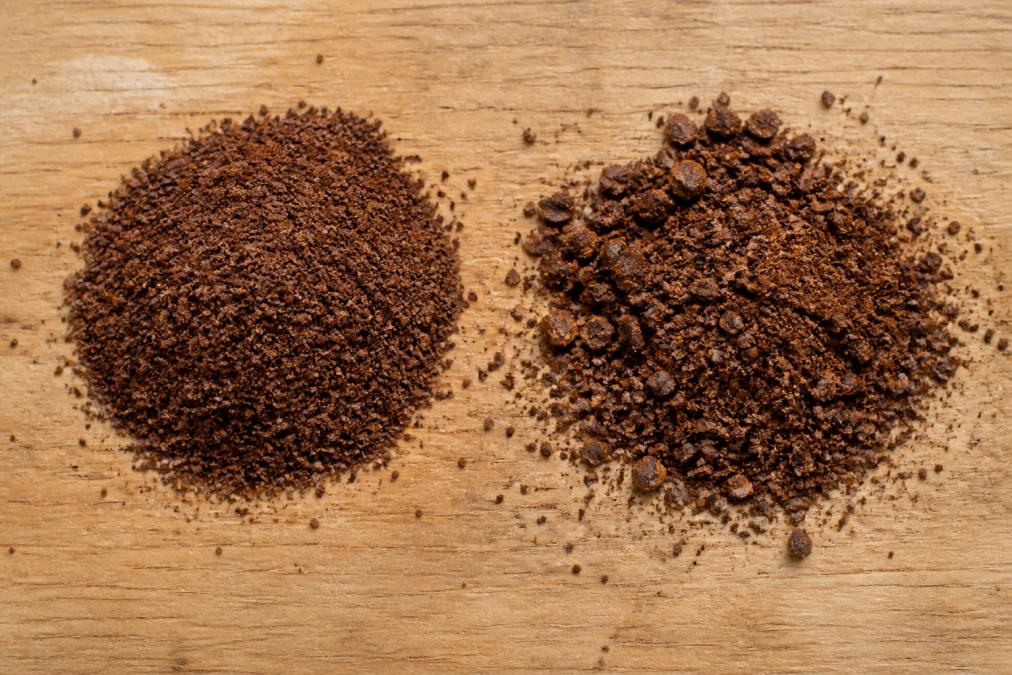
Grind consistency is the measure of how evenly sized the particles in a batch of coffee are, and it directly determines how evenly your coffee extracts. Uniform particles extract at the same rate. Mixed particles do not.
Why Fines and Boulders Ruin Your Brew
Fines are the dusty particles that slip through a blade grinder's chaos. Boulders are the oversized chunks that survive it. When you brew, hot water reaches the fines first and pulls out harsh, bitter compounds before the boulders have given up anything at all. The result is a cup that tastes both bitter and weak at once, which is a frustrating combination to diagnose.
How Grind Consistency Affects Flavor and Extraction Yield
Extraction yield is the percentage of a coffee bean's mass that dissolves into your cup, and grind consistency is one of the biggest levers on it. When particles are uniform, you can dial in a target extraction and hit it repeatedly. When they are not, you are adjusting blind.
Conical vs Flat Burr Grinders: What's the Difference?
Conical burr grinders use a cone-shaped inner burr spinning inside a ring-shaped outer burr. Flat burr grinders use two parallel discs facing each other. Conical burrs typically run cooler and quieter, and they are easier to align. Flat burrs tend to produce a narrower particle size distribution, which many espresso drinkers prefer for flavor clarity.
| Feature | Conical Burrs | Flat Burrs |
|---|---|---|
| Burr shape | Cone inside ring | Two parallel discs |
| Typical noise | Quieter | Louder |
| Heat buildup | Lower | Higher at speed |
| Particle uniformity | Good | Excellent |
| Best for | Drip, French press, pour-over | Espresso, precision brewing |
| Price tier | Often more affordable | Often costs more |
Coffee Grind Size Chart: Matching Grind to Brewing Method
The right grind size depends entirely on how long water contacts the coffee and how the brewing method works. Use this coffee grind size chart as a starting point, then adjust to taste.
| Brewing Method | Grind Size | Texture Reference |
|---|---|---|
| French press | Coarse | Sea salt |
| Drip coffee | Medium | Table salt |
| Pour-over | Medium-fine | Fine sand |
| Espresso | Fine | Powdered sugar |
| Cold brew | Extra coarse | Peppercorns |
Cost, Noise, and Heat: What Most Comparisons Miss
Cost is the obvious trade-off, and it is worth being honest about it. Blade grinders are inexpensive and widely available at big-box retailers and grocery stores. Burr grinders cost more upfront, but they are the single biggest upgrade most home brewers can make. Pricing varies widely by brand and burr type, so check current listings rather than trusting a fixed number.
Motor Speed and Friction Heat in Blade Grinders
Blade grinders spin fast, often in the range of 20,000 to 30,000 RPM, and fast spinning creates friction heat that warms the grounds before you ever brew them. That heat can drive off some of the volatile aromatics you paid for, and it can start to alter the oils on the surface of the coffee. Burr grinders run much slower, often a few hundred RPM at the burr, and generate far less friction heat, which helps preserve coffee oils and flavor clarity.
The Hidden Cost of Inconsistency
The real cost story is not the sticker price. It is the coffee you waste dialing in a grind you cannot repeat. With a blade grinder, every batch is a new guess, so you over-correct, under-correct, and pour out cups that do not taste like the last one. With a burr grinder, the setting is repeatable, so the same beans and the same dose produce the same cup.
Cleaning, Maintenance, and Longevity
Most comparisons stop at 'blade grinders are easy to clean, burr grinders last longer.' That is true but useless without specifics. Here is what actually happens to each machine over time.
What Fails First on a Blade Grinder
A blade grinder has three wear points: the motor, the blade assembly, and the plastic chamber. The motor is usually the first to go, because it is a small, high-RPM motor that was never designed for daily use. The blade dulls and starts smearing rather than cutting, which makes the grind even more uneven. The plastic chamber scratches and holds onto oils and fine dust, which goes stale and flavors the next batch.
What Lasts on a Burr Grinder
A burr grinder's wear part is the burr set itself. Steel burrs are rated by manufacturers for hundreds of pounds of coffee before replacement, for a typical home brewer using a pound or two a month, that is years of service. The motor runs slower and cooler, so it is under far less stress. The trade-off is that burr grinders need more care: grounds pack into the chute and around the burr carrier, and if you never clean them out, retention builds up and old coffee flavors every new dose.
Cleaning Difficulty, Compared Honestly
Blade grinders win on surface cleaning, wipe the chamber, brush the blade, done. But you cannot easily get inside the motor housing, and you should never run water through it. Burr grinders are more involved: you remove the hopper, lift out the upper burr, brush both burr faces, clear the chute, and reassemble. It takes a few minutes rather than a few seconds.
A few habits extend the life of either machine:
- Brush out grounds after every few uses to prevent buildup
- Avoid washing burrs with water; use a dry brush or grinder cleaning tablets
- Empty the hopper if you will not brew for several days
- Check burr alignment periodically on burr grinders
- Replace worn burrs rather than the whole grinder
Static and Retention: The Quiet Annoyances
Static electricity and retention are the two problems nobody warns you about. Static makes grounds cling to the chute, the lid, and the counter. Retention means a small amount of old coffee stays behind in the grinder and comes out in your next dose. A drop of water on the beans before grinding reduces static, and single-dose grinding keeps retention low.
Conclusion
Grind consistency is the foundation of good coffee, and the burr vs blade choice decides whether you get it. A blade grinder chops unevenly and leaves you guessing. A burr grinder gives you control, repeatable settings, and a cup that reflects your beans instead of fighting them.
Frequently Asked Questions
What are the advantages of using a burr grinder instead of a blade grinder?
Burr grinders produce uniform particle sizes because the burrs crush beans to a consistent setting. This uniformity leads to even extraction, which means better flavor clarity and less bitterness. Blade grinders chop unevenly, creating both fine powder and large chunks in the same batch. For anyone brewing pour-over, espresso, or French press, a burr grinder gives you control over grind settings that a blade simply cannot match.
Is a blade grinder ok for espresso?
No. Espresso requires a very fine, highly consistent grind to build proper pressure during extraction. Blade grinders produce a mix of fines and boulders that causes channeling, where water pushes through weak spots instead of evenly saturating the puck. The result is sour, under-extracted shots or harsh, over-extracted ones. A burr grinder with stepless or fine stepped adjustments is necessary for espresso.
Do blade grinders heat up the coffee beans during the grinding process?
Yes. Blade grinders spin at high motor speeds, and the friction heat generated during grinding can warm the beans. This heat exposure can degrade delicate coffee oils and aromatic compounds, flattening the flavor before you even brew. Burr grinders run slower and generate less friction heat, which helps preserve the volatile compounds that give freshly roasted coffee its distinct character.
What is the difference between conical and flat burr grinders?
Conical burr grinders use a cone-shaped inner burr that spins inside a ring burr, while flat burr grinders use two parallel discs. Conical burrs typically produce a slightly wider particle size distribution and are quieter, making them popular for home use. Flat burrs tend to deliver more uniform particles and are favored in professional settings for espresso. Both outperform blade grinders, but the choice depends on your brewing method and budget.