

How Long Do Coffee Beans Stay Fresh After Opening?
Table of Contents
- How Long Coffee Beans Stay Fresh After Opening: A Timeline
- Signs of Stale Coffee Beans You Can Spot Before Brewing
- The Best Way to Store Coffee Beans for Maximum Freshness
- Freezing Coffee Beans: When It Works and How to Do It Right
- How to Tell If Coffee Beans Have Gone Bad vs. Just Stale
- Roast Level, Bean Density, and Processing: Why Freshness Timelines Differ
- Sensory Testing: A Simple Guide to Evaluating Your Beans
- Climate-Specific Storage and Repurposing Stale Beans
- Frequently Asked Questions
Last Updated: September 25, 2026
How Long Coffee Beans Stay Fresh After Opening: A Timeline
Most whole bean coffee stays at its best for about two to four weeks after you open the bag, though how long do coffee beans stay fresh after opening depends on more than that window alone. The honest answer to how long do coffee beans stay fresh after opening depends on three things: the roast date, how the beans are stored, and how quickly you drink them.
Freshness timeline by format:
- Whole bean, opened bag: Peak flavor for 2-4 weeks; drinkable for 2-3 months
- Ground coffee, opened bag: Peak flavor for 3-7 days; noticeably stale within 2-3 weeks
- Whole bean, unopened with a one-way valve: Peak flavor for 4-8 weeks from roast date
- Frozen whole bean: Peak flavor preserved for 1-2 months if sealed properly
- Single-serve capsules: Sealed with no oxygen inside, so they hold flavor far longer than an open bag
Signs of Stale Coffee Beans You Can Spot Before Brewing
Stale coffee announces itself before you ever taste it. The clearest signs of stale coffee beans are a dull, matte surface, a weak or missing aroma when you open the bag, and beans that feel light and dry rather than dense. Fresh beans smell sweet and complex; old beans smell like cardboard or sawdust.
A few more tells worth checking:
- No bloom when you brew. Fresh grounds puff and bubble when hot water hits them as carbon dioxide escapes. Flat, still grounds mean the gas is long gone.
- Oily or chalky surface. Some oil is normal on darker roasts, but a slick, greasy sheen on beans that were once matte often signals oil degradation.
- Flat, bitter, or papery flavor. Bitterness without sweetness or acidity usually points to oxidation, not your brewing method.
The Best Way to Store Coffee Beans for Maximum Freshness
The four enemies, ranked by how fast they work:
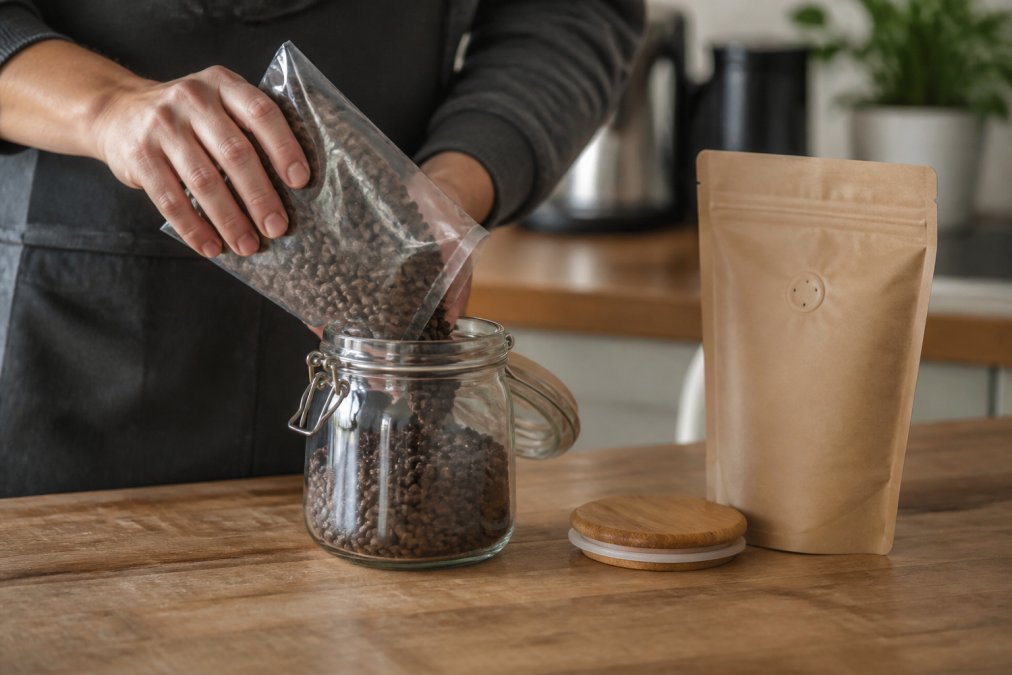
- Oxygen is the primary driver. It reacts with the oils and aromatic compounds on the bean surface, a process called oxidation. The more surface area exposed, the faster it happens, which is why ground coffee stales in days and whole beans take weeks.
- Moisture is the second-fastest threat. Water accelerates oxidation and can introduce mold if beans sit damp. This is the reason the refrigerator is a trap, not a solution.
- Heat speeds up every chemical reaction, including the ones you're trying to slow. A bag on top of the fridge or beside the oven ages faster than the same bag in a pantry.
- Light breaks down the oils that carry aroma. Ultraviolet exposure is slow but cumulative, which is why opaque beats clear glass over a month-long window.
Container options, honestly compared:
- The original bag with a one-way valve. If your bag has a valve, it's already doing real work: it releases carbon dioxide during degassing while blocking oxygen from entering. Squeeze the air out, reseal with the tin tie, and you have a functional short-term container. The weakness is that most bags aren't fully opaque and the seal degrades with repeated opening.
- Airtight opaque canisters with a one-way valve. These combine the bag's valve benefit with a rigid seal and full light block. Look for a gasket seal and a valve, not just a latch. A latch alone doesn't stop oxygen.
- Vacuum containers. These pull air out mechanically and can extend peak flavor, but the pumping action and the vacuum itself can pull aromatic oils off the bean surface over time. Good for medium-term storage, less ideal for beans you'll finish in two weeks.
- Clear glass jars. Popular and photogenic, but they fail the light test unless stored inside a dark cabinet. If you use glass, keep it in the pantry, not on the counter.
- The refrigerator. Skip it. Every door opening swings the temperature and pulls condensation onto the beans, and moisture is worse for them than steady room temperature. The fridge is for freezing, not for daily storage.
The variable most guides ignore: how often you open the container. Every time you open it, you exchange the carbon-dioxide-rich headspace for oxygen-rich room air. A container you open twice a day ages faster than one you open twice a week, even if both are perfectly sealed. If you brew one cup at a time, consider portioning a week's worth into a smaller container and leaving the bulk sealed. That single habit often does more for freshness than upgrading the container itself.
Freezing Coffee Beans: When It Works and How to Do It Right
Freezing coffee beans works well, but only if you seal them properly and never thaw and refreeze. Portion whole beans into airtight bags, squeeze out the air, and freeze in amounts you'll use within a week or two. Take a portion out, let it come to room temperature before grinding, and leave the rest frozen.
How to Tell If Coffee Beans Have Gone Bad vs. Just Stale
Coffee beans don't really "expire" in a safety sense the way milk does. They go stale, meaning they lose aroma and flavor, long before they become unsafe. The distinction matters: stale beans are disappointing, but beans that have gone bad show visible mold, a sour or musty smell, or clumping from moisture, and those you should throw out.
Roast Level, Bean Density, and Processing: Why Freshness Timelines Differ
Darker roasts go stale faster than lighter ones because the roasting process brings oils to the surface, where they meet oxygen. A dark, oily bean has a shorter freshness peak than a light, dry one. That's the headline, but the mechanism behind it is what lets you predict how any given bag will age.
- Washed process. The fruit is removed before drying, leaving a cleaner, denser bean surface. These tend to hold up slightly longer because there's less residual organic material on the surface to oxidize.
- Natural process. The fruit dries onto the bean, leaving sugars and organic residue on the surface. That residue is flavorful but also more reactive, so natural-process beans can fade faster and can develop a fermented, muted character as they age.
- Honey and other hybrid processes. These sit between the two, with some surface residue retained. Expect aging behavior closer to natural than washed.
Sensory Testing: A Simple Guide to Evaluating Your Beans
Sensory evaluation is the practice of judging coffee through smell, sight, and taste rather than relying on a date stamp. You can run a quick sensory test any time you're unsure about a batch. It takes about five minutes and tells you more than any label.
Try this sequence:
- Smell the whole beans straight from the container. Sweet, fruity, or chocolatey notes mean they're still alive.
- Rub a few beans between your fingers and smell again. Warmth releases aroma; a weak result signals fading freshness.
- Grind a small amount and smell the grounds. This is where a stale bean is hardest to hide.
- Brew a small cup and taste for acidity and sweetness. If both are gone and only bitterness remains, the beans are past their peak.
- Check the bloom. A healthy bloom confirms carbon dioxide is still present.
Climate-Specific Storage and Repurposing Stale Beans
Humidity changes everything. In a humid climate, moisture is your main threat, so airtight sealing matters more than ever and the fridge is off the table. In a dry climate, the risk shifts toward the beans drying out and losing oils, so keeping them sealed and out of direct light becomes the priority. Either way, storage conditions, not just the container, decide how long flavor lasts.
Frequently Asked Questions
Do coffee beans go bad if opened?
Yes, opened coffee beans go stale, but they don't become unsafe to drink like spoiled milk. Staleness is about flavor loss, not food safety. After opening, whole beans stay fresh for about 2 to 4 weeks if stored properly. Ground coffee deteriorates faster, often within 1 to 2 weeks. The main culprits are oxygen, moisture, heat, and light, which speed up oxidation and degrade the oils that carry aroma and flavor. For the best cup, use beans within a few weeks of opening and store them in an airtight container away from light and heat.
Can I still use 2-year-old coffee beans?
Two-year-old coffee beans are safe to consume but will taste flat and stale. The oils have oxidized, leaving little aroma and a dull, sometimes bitter or cardboard-like flavor. If you find a forgotten bag, don't brew it as your morning cup. Instead, repurpose the beans: grind them and use as a body scrub, deodorizer for the fridge, or compost. For drinking, always check the roast date and aim to use beans within a few weeks of opening for the best flavor.
Does storing coffee in the freezer keep it fresh longer?
Freezing coffee beans can extend freshness, but only if done correctly. Use an airtight, freezer-safe container or vacuum-sealed bag to prevent moisture and freezer burn. Freeze in small portions you'll use within a week or two, and never thaw and refreeze. When ready to brew, take out only what you need and let it come to room temperature before grinding to avoid condensation. Done right, freezing can keep beans fresh for up to 2 months. Done wrong, it introduces moisture and stale flavors.
How can you tell if coffee beans have gone stale?
Signs of stale coffee beans include a dull, matte appearance instead of a shiny, oily surface; a lack of aroma when you open the bag; and beans that feel dry and brittle. When brewed, stale beans produce a flat, lifeless cup with muted acidity and a cardboard or papery taste. Fresh beans often bloom (bubble and expand) when hot water hits them, while stale beans barely react. If your coffee tastes bland no matter how you brew it, staleness is likely the cause. Check the roast date and storage conditions to confirm.
The real challenge with coffee freshness is that the clock starts before you're even aware of it, and most bags give you no clear roast date to work from. Gospel and Grind solves that by roasting to order for maximum flavor and aroma, sourcing carefully from trusted farms, and delivering fast and reliably to your door. Every purchase also supports the mission to fight homelessness one cup at a time. Find your perfect roast and start brewing coffee that tastes as fresh as the day it was roasted.