

How to Clean Your Coffee Equipment Properly: 2026 Guide
Table of Contents
- Why Clean Coffee Equipment Changes How Your Coffee Tastes
- Daily Rinses vs. Deep Cleaning: What Each One Removes
- Cleaning Coffee Equipment Frequency: A Simple Schedule
- How to Clean a Carafe, Reservoir, and Portafilter
- How to Descale a Coffee Maker Without Damaging It
- How to Clean Coffee Grinder Burrs the Right Way
- Water Quality, Residue Problems, and Eco-Friendly Disposal
- Frequently Asked Questions
Last Updated: September 28, 2026
Why Clean Coffee Equipment Changes How Your Coffee Tastes
If your morning cup tastes flat, bitter, or like cardboard, the residue coating your machine is likely the problem, not the beans, and learning how to clean your coffee equipment properly is the fastest way to fix it. Learning how to clean your coffee equipment properly is the fastest way to improve flavor, and it costs nothing but time.
Daily Rinses vs. Deep Cleaning: What Each One Removes
A daily rinse removes fresh oils and loose grounds; a deep clean removes dried oil films, mineral scale, and residue inside gaskets and valves. You need both, confusing the two is the most common mistake home brewers make.
- Daily rinse: flush the brew path, rinse the carafe, wipe the steam wand
- Weekly deep clean: detergent wash of the portafilter, basket, and shower screen
- Monthly descale: dissolve mineral buildup in the reservoir and boiler
Cleaning Coffee Equipment Frequency: A Simple Schedule
Cleaning coffee equipment frequency depends on water hardness and shot volume, but a fixed schedule removes the guesswork. Use this baseline, adjusting upward if you brew heavily or live in a hard water area.
| Task | Frequency | What It Removes |
|---|---|---|
| Rinse carafe and portafilter | After every use | Fresh oils, grounds |
| Flush steam wand | After every use | Milk residue |
| Detergent backflush | Weekly | Oils inside the brew head |
| Scrub shower screen and gasket | Weekly | Dried residue, grit |
| Descale reservoir and boiler | Monthly | Calcium and mineral scale |
| Clean grinder burrs | Monthly | Oils, chaff, fines |
Daily, Weekly, and Monthly Tasks by Machine Type
Espresso machines demand the most attention because milk and pressure push residue deeper into the brew head. Drip makers are more forgiving, but their reservoirs scale up faster since water sits in them. Grinders need burr cleaning on their own clock, since oily beans coat the burrs and stale grounds collect in the chute.
How to Clean a Carafe, Reservoir, and Portafilter
Start with the parts you touch every day, since they hold the most oil. Warm water, a soft brush, and a little dish soap handle 90% of it.
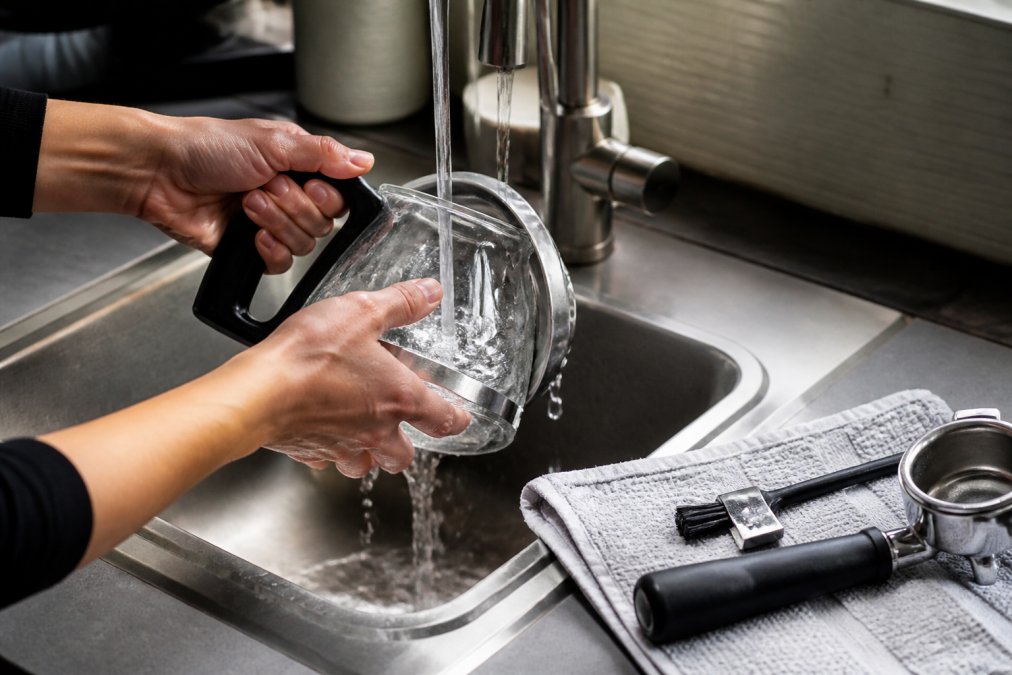
Removing Coffee Oils From a Carafe or French Press
Fill the carafe or press with warm water and a drop of dish soap, then scrub with a soft bottle brush. For stubborn film, add a spoonful of baking soda and let it sit a few minutes before rinsing. Never use abrasive pads, scratches give oils a place to hide.
Scrubbing the Portafilter, Basket, and Shower Screen
Remove the basket from the portafilter and wash both separately. Scrub the shower screen with a stiff brush, especially the gasket ring where grounds pack in. A blind filter and detergent backflush clears brew head internals a surface scrub can't reach.
How to Descale a Coffee Maker Without Damaging It
Descaling dissolves the mineral scale inside your reservoir, boiler, and lines. Scale is mostly calcium carbonate: it insulates heating elements, restricts flow, and gives coffee oils a rough surface to cling to. Left long enough, it can kill a machine outright, a scaled boiler overheats because heat can't transfer through the deposit.
Match the Method to the Machine
| Machine Type | Descaler to Use | Typical Soak | Watch Out For |
|---|---|---|---|
| Drip brewer with glass carafe | Citric acid or commercial descaler | 20-30 min | Don't exceed the manufacturer's cycle count; reservoirs on drip makers scale fastest because water sits |
| Drip brewer with thermal carafe | Citric acid or commercial descaler | 20-30 min | Thermal carafes can't be scrubbed with abrasives; rinse thoroughly or the stainless holds odor |
| Pump espresso machine (single boiler) | Commercial descaler formulated for espresso | 15-20 min per cycle | Never let solution sit in the boiler overnight; seals and brass fittings corrode |
| Dual boiler / heat exchanger espresso machine | Commercial descaler, manufacturer-approved only | Follow the machine's program | Some machines require a specific descaling mode that bypasses the brew boiler, check the manual |
| Super-automatic | Manufacturer's proprietary descaler tablet or liquid | Machine-programmed | Third-party descalers can void the warranty and clog the brewing unit |
| Pod machine | Manufacturer's descaler only | Machine-programmed | Most pod systems have a dedicated descale cycle; running vinegar can damage the thermoblock |
If your machine has a descaling program, use it. It controls pump timing and temperature in a way you can't replicate by hand, and it's the only method the warranty recognizes.
The Manual Descaling Sequence
- Empty the reservoir and fill it with descaler at the label's dilution. More concentrated is not better, it can pit metal and dry out seals.
- Run a partial brew cycle to push solution into the lines, then pause for the soak time in the table above.
- Run the rest of the cycle and discard the output. Don't drink it, and rinse the sink afterward if you use it for food prep.
- Refill with clean water and run two or three full rinse cycles. Espresso machines often need more, run until the water exiting the group head tastes neutral.
- Taste-test a plain cup of hot water before brewing coffee again. If it tastes acidic or soapy, run another rinse cycle.
Vinegar vs. Citric Acid vs. Commercial Descaler
Vinegar works because acetic acid dissolves calcium carbonate, and it's already in most kitchens. The trade-offs are real: the smell lingers in seals and tubing, repeated use degrades rubber gaskets and O-rings faster than citric acid, and as a weak acid it needs longer contact time.
How Often to Descale
Descaling frequency is driven by water hardness, not the calendar. A machine fed soft water might go three months between descales; the same machine on very hard water might need one every three to four weeks. Signs you're overdue: slower brew times, a hissing or sputtering pump, a white chalky film in the reservoir, or coffee that tastes flat even after a deep clean.
How to Clean Coffee Grinder Burrs the Right Way
Grinder burrs collect oil and fine powder that go stale fast, and those stale fines end up in every subsequent cup. Cleaning them takes about fifteen minutes and does more for flavor than most upgrades.
Water Quality, Residue Problems, and Eco-Friendly Disposal
Most cleaning guides treat water as an afterthought. It isn't. Water is roughly 98% of what comes out of your machine, and its mineral content decides how often you descale, how fast seals wear, and whether your coffee tastes clean or chalky.
Water Hardness Drives Your Cleaning Schedule
Hardness is measured in grains per gallon (gpg) or milligrams per liter as calcium carbonate (mg/L CaCO3). The U.S. Geological Survey classifies water roughly as follows:
| Hardness (gpg) | Classification | Practical Impact on Coffee Equipment |
|---|---|---|
| 0-3.5 | Soft | Minimal scaling; descale every 2-3 months |
| 3.5-7 | Moderately hard | Scale visible in weeks; descale monthly |
| 7-10.5 | Hard | Descaling every 3-4 weeks; consider softening |
| 10.5+ | Very hard | Descaling every 2-3 weeks; untreated water will shorten machine life |
What Filtration Actually Fixes
Not all filters do the same job, and the wrong one wastes money.
- Carbon filters (pitcher or inline): Remove chlorine, chloramine, and some taste-and-odor compounds. They do not remove calcium or magnesium, so they don't reduce scale, but they do improve flavor noticeably.
- Ion-exchange softeners: Replace calcium and magnesium with sodium or hydrogen. These genuinely reduce scale, but they can make water taste flat or salty if over-softened.
- Reverse osmosis (RO): Removes nearly everything, including the minerals that give coffee its body. RO water usually needs remineralization before brewing, or the coffee tastes hollow.
- Espresso-specific filtration: Brands sold for commercial espresso use blend carbon and ion-exchange media to hit a target hardness and alkalinity. They're the most expensive option but the most precise.
Diagnosing Off-Flavor: Residue vs. Old Oils
When coffee tastes wrong, the cause is usually one of three things. Here's how to tell them apart.
| Taste | Likely Cause | Fix |
|---|---|---|
| Soapy, chemical, or floral-perfume | Detergent residue in the brew path | Run two or three plain-water cycles; check the gasket and shower screen for trapped detergent |
| Flat, cardboard, or rancid | Oxidized coffee oils on the brew path | Detergent backflush, scrub the shower screen and gasket, clean the grinder burrs |
| Chalky, dry, or astringent | Mineral scale in the boiler or lines | Descale the machine |
| Metallic or bitter | Corroded or pitted metal from over-acidic descaler | Stop using that descaler; inspect seals and fittings |
| Sour but clean-tasting | Under-extraction, not a cleaning problem | Adjust grind or dose; don't clean again |
Disposing of Cleaning Solutions Safely
Descaling solutions are acidic, and some commercial cleaners contain chelating agents and surfactants that shouldn't go down the drain undiluted.
- Citric acid solution: Generally safe to dilute heavily with water and pour down a drain that gets regular use. Follow with a full rinse of the sink.
- Vinegar solution: Same as citric acid, dilute and flush. The smell dissipates within a day.
- Commercial descaler: Read the label. Many are formulated to be drain-safe at the dilution you used; some are not. If the label says to dispose of it as hazardous waste, take it to a municipal household hazardous waste facility.
- Detergent backflush water: Usually safe to dilute and discard, but check the label for phosphates or chlorine, which can harm septic systems at high concentrations.
- Never mix a descaler with a chlorine bleach product. The reaction releases chlorine gas, which is dangerous in a kitchen.
Filtered water is the cheapest maintenance upgrade you can make. It reduces descaling frequency, protects every seal and valve in the machine, and improves flavor, all for less than the cost of one descaling kit per year.
Frequently Asked Questions
What should I run through my coffee machine to clean it?
Plain water handles daily rinses, but a proper clean coffee equipment routine needs a descaling solution for mineral buildup. White vinegar (acetic acid) or citric acid both dissolve calcium deposits, though citric acid leaves less odor. Run the solution through a full brew cycle, let it sit 15-30 minutes, then flush with two or three cycles of fresh water. For espresso machines, use a dedicated backflushing detergent with a blind filter to clear coffee oils from the brew head.
How often should you deep clean your coffee equipment?
Cleaning coffee equipment frequency depends on use. Rinse the carafe, portafilter, and drip tray daily. Deep clean the reservoir, brew basket, and steam wand weekly. Descale monthly if you have hard water, or every two to three months with soft water. Grinder burrs need brushing every week or two and a full disassembly every one to two months. If your coffee tastes bitter or rancid, or water flows slower than usual, clean sooner regardless of schedule.
Is vinegar or citric acid better for descaling a coffee maker?
Both work, but citric acid is generally the safer choice. Vinegar is cheap and effective at breaking down calcium deposits, yet its smell lingers and acetic acid can degrade rubber gaskets over repeated use. Citric acid dissolves scale just as well, rinses clean, and leaves no aftertaste. Whichever you pick, always follow with two or three plain water cycles, and never mix the two. Check your machine's manual first, since some manufacturers require a specific descaler.
Can soap damage the internal components of a coffee machine?
Dish soap is fine for removable parts like carafes, baskets, and drip trays, but never run it through the machine's internal water path. Soap residue coats tubing, pumps, and gaskets, and it is difficult to rinse out completely, which affects flavor and can shorten component life. For internal cleaning, stick with water, vinegar, citric acid, or a manufacturer-approved descaler. Backflushing detergent is designed for espresso brew heads only, not for drip machines.