

How to Tell If Coffee Beans Are Under Roasted
Table of Contents
- Start With Your Roast Log, Not Your Eyes
- Under-Roasted Coffee Beans Appearance: What to Look For
- Under-Roasted Coffee Taste: Sour, Grassy, and Thin
- Under-Roasted vs. Light Roast Coffee: The Line That Matters
- Is It the Roast or the Brew? How to Fix Under-Extracted Coffee
- What to Do With a Batch You Think Is Under Roasted
- Conclusion: Trust the Checks, Then Trust Your Roaster
- Frequently Asked Questions
Last Updated: October 12, 2026
Start With Your Roast Log, Not Your Eyes
Learning how to tell if coffee beans are under roasted starts with your roast log, not the bag.
At Gospel and Grind, we roast to order, so every batch ships within days of the roast date. That freshness makes roast defects easier to spot early.
Here is what a roast log should tell you:
- Total roasting time and how it compares to your usual profile
- First crack timing: when it started and how long it lasted
- Development time: the gap between first crack and drop
If you buy from a roaster, ask for the roast date and intended roast level.
Under-Roasted Coffee Beans Appearance: What to Look For
Under-roasted coffee beans appearance gives the fastest visual read, but only if you inspect consistently: pale, uneven, dry, matte, closer to tan or yellow than brown.
A Repeatable Five-Minute Inspection Protocol
Do this in the same order and light every time so notes stay comparable.
- Weigh and spread. Pour about 30 grams onto a white plate or paper. A wood counter or dark tray shifts your color read.
- Check the color under daylight or a 5000K bulb. A yellow or tan cast signals a roast that stopped early; a proper light roast reads light brown.
- Check the surface. Under-roasted beans look dry and chalky, but dryness alone is not proof, a matte bean is normal for light roasts.
- Check for uneven patches. Blotchy light-and-dark spots point to uneven heat or a fast roast. Sort into "even" and "blotchy" piles and note the ratio.
- Check the aroma. A toast-like or grassy, hay-like note is a classic under-roasted signal; fragrance should smell sweet and roasty. Cup your hands over the grounds and smell within 30 seconds of grinding.
- Check for cracked beans. Beans that split oddly or feel dense and hard often skipped full development. Press one between your thumbnails, a developed bean gives slightly; an under-developed one feels like a pebble.
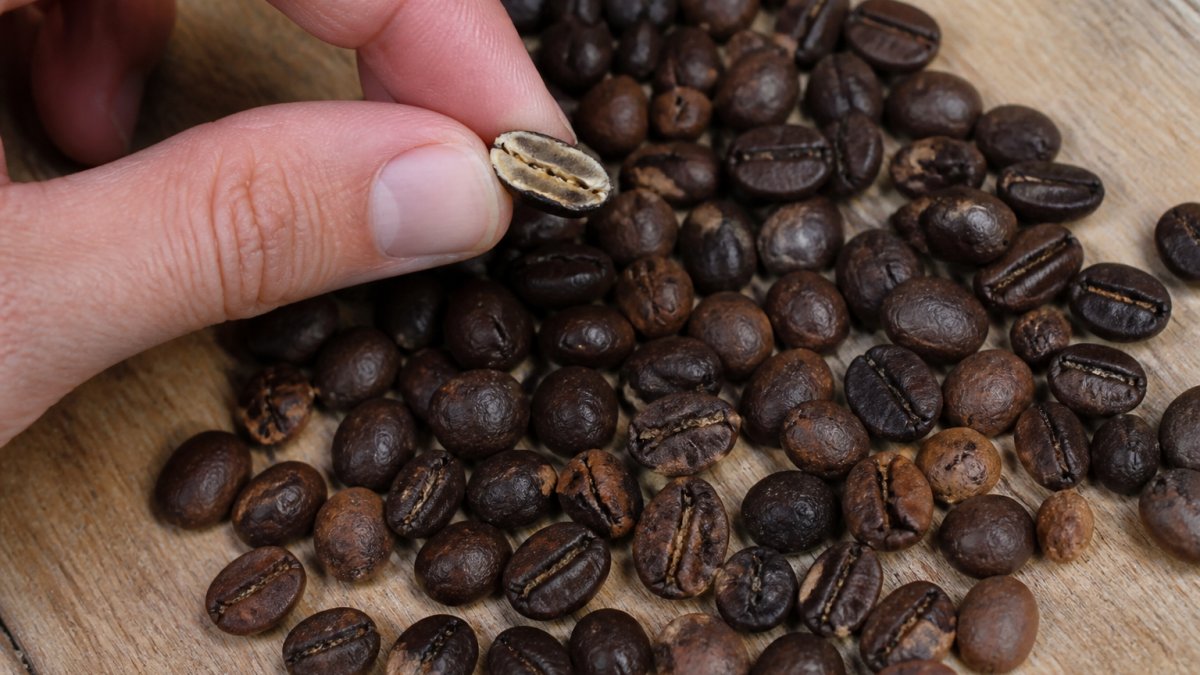
The Cross-Section Check That Settles Arguments
Break a bean in half and look inside.
A fully developed bean is even brown throughout; an under-roasted one has a pale center, meaning heat never reached the middle and the sugars never caramelized.
Split the bean along its flat side with a sharp knife or your front teeth, crushing smears the interior and hides the color difference.
Under-roasted beans also feel denser and heavier than they should, since full development expands the bean and drops weight through moisture loss.
Context Matters: Origin, Processing, and Intended Roast Style
Color and density vary naturally by bean, so a pale bean is not automatically a defect.
- Origin and variety. High-grown, dense beans, many East African lots, finish lighter at the same drop temperature than softer, lower-grown beans. A washed Ethiopian at a light roast can look almost tan and still be fully developed.
- Processing method. Natural (dry-process) coffees look darker and more uneven because fruit sugars remain on the bean; washed coffees look cleaner and more uniform. A blotchy natural is not the same as a blotchy washed bean.
- Intended roast style. A Nordic-style light profile drops earlier than an espresso roast. Judge the bean against the stated intent, not a generic color chart.
Home roasters often panic over a well-executed light roast. Before calling a batch under-roasted, confirm the intended roast level with the roaster or your log. If the intent was light and the cup has sweetness under the acidity, the bean is fine.
Quick Reference: What Each Visual Signal Actually Means
| What you see | Likely cause |
|---|---|
| Uniform pale tan, dry surface, even interior | Deliberate light roast |
| Pale tan with pale or light core | Under-roasted, heat never reached center |
| Blotchy light and dark patches | Uneven heat or too-fast roast |
| Dark surface, pale interior | Roast stalled after first crack |
| Very dense, heavy beans for the color | Incomplete development |
Use the table as a starting point, not a verdict, the cup and cross-section together confirm the diagnosis.
Under-Roasted Coffee Taste: Sour, Grassy, and Thin
Under-roasted coffee taste is sharp in a specific way: sourness that bites, a grassy or vegetal note, and a thin, watery body.
Good acidity is bright and fruity; under-roasted acidity makes you wince, the difference between bright notes and a roast defect.
Watch for these cup signals:
- Sourness that dominates rather than sits behind sweetness
- Grassy, green, or hay-like flavors instead of fruitiness or nuttiness
- Thin, weak body even when you used a normal dose of coffee
Fragrance in the dry grounds is another tell: sweet and roasty means the roast developed; raw, grainy, or toast-like means it did not.
Under-Roasted vs. Light Roast Coffee: The Line That Matters
Under-roasted vs. light roast coffee is not the same thing, and confusing them makes people write off good coffee.
The line comes down to intent and development:
| Signal | Light Roast | Under-Roasted |
|---|---|---|
| Bean color | Light brown, even | Pale tan or yellow, blotchy |
| Surface | Dry, matte | Dry, chalky, uneven |
| Interior | Even brown core | Pale or light center |
| Aroma | Sweet, fruity, floral | Grassy, raw, toast-like |
| Cup | Bright, sweet, balanced | Sour, grassy, thin |
| Development | Complete for the profile | Cut short before first crack finished |
A light roast tastes bright and sweet with clear fruitiness; an under-roasted bean tastes sour and green, with no sweetness to balance it.
The practical test: sweetness under the acidity means a light roast; acidity alone with a grassy edge and no sweetness is a roast defect.
Is It the Roast or the Brew? How to Fix Under-Extracted Coffee
Under-extraction and under-roasting produce similar symptoms, so people misread the problem. Under-extraction happens during brewing when water pulls too little from the grounds; under-roasting happens during the roast, before the beans reach your grinder.
Here is how to tell them apart:
- Grind finer and brew again. If the cup gets sweeter and fuller, the problem was extraction, not the roast.
- Raise your water temperature. Under-extracted coffee often comes from water that is too cool.
- Extend brew time. A longer contact time pulls more from the grounds.
A quick formula: if a finer grind and hotter water still leave a thin, sour cup, stop adjusting the brew, the roast is the variable you cannot fix at the grinder.
What to Do With a Batch You Think Is Under Roasted
A suspected under-roasted batch is not wasted, but the next step depends on whether you roasted it or bought it, and how far off the roast is. Work through this path in order.
Step 1: Confirm the Diagnosis Before You Act
Run both checks before changing anything:
- The cross-section check. Split five beans. Even brown interiors mean the roast is likely fine and the problem is the brew; pale centers mean a real roast issue.
- The brew-adjustment test. Grind one notch finer, raise water temperature about 5°F (to roughly 200-205°F), and extend the brew 20-30 seconds. A sweeter, fuller cup means the problem was under-extraction, not under-roasting.
Only if the cross-section shows pale centers and brew adjustments fail to add sweetness should you treat the batch as under-roasted.
Step 2: If You Bought the Beans
- Rest the beans a few more days. Freshly roasted coffee releases carbon dioxide and settles. A slightly light batch can round out after a week. This helps borderline roasts; it will not rescue a bean that never developed.
- Adjust your brew. A finer grind, hotter water, and longer brew time pull more sweetness from a borderline batch, a mitigation, not a fix.
- Blend it. A 70/30 blend of your normal roast to the suspect batch often balances the cup without hiding the good coffee.
Step 3: If You Roasted It Yourself, Read Your Roast Log
This step prevents the next bad batch. Pull up your log and look for these measurable indicators:
- Development time ratio (DTR). Time from first crack to drop divided by total roast time. Many home roasters aim for roughly 20-25% DTR for a light-to-medium roast; well under 20% is a common signature of under-development.
- First crack timing and duration. A roast dropped seconds after first crack began almost always tastes under-developed.
- Rate of rise (RoR) near the end. A rate of rise that flattens hard or crashes in the final minute often means the roast stalled, heat was cut too early.
A common pattern: first crack hit late, then an immediate drop for fear of going too dark. The fix is not a darker roast but a longer development window at a gentler rate of rise.
Step 4: Adjust the Next Roast
If you roast at home, run the batch again with these changes, one at a time so you can tell what worked:
- Extend development time 30-45 seconds past first crack before dropping.
- Slow the rate of rise in the last two minutes by reducing heat earlier.
- Keep total roast time similar to isolate development change from overall roast change.
Step 5: When to Just Replace the Batch
Some batches are not worth saving. A wide pale core across most beans, an aggressively grassy cup with no sweetness after resting and brew adjustments, or a DTR far below target means a learning batch.
To skip the guesswork, order beans roasted to order. Our Ethiopia Natural is a medium-light roast with milk chocolate, fruity, and caramel notes, and our Tanzania is a medium-light roast with pear, floral, jasmine, and strawberry.


Conclusion: Trust the Checks, Then Trust Your Roaster
Learning how to tell if coffee beans are under roasted comes down to a few reliable checks: color, surface, cross-section, the smell of the grounds, and sourness with no sweetness behind it.
The harder truth: most people cannot fix a roast defect at home.
Gospel and Grind roasts to order for maximum flavor and aroma, sources beans from trusted farms, and delivers straight to your door. Every purchase also supports the fight against homelessness.
Frequently Asked Questions
How can you tell if coffee beans are under roasted?
Check three things in order. First, the color: under roasted coffee beans look pale tan or light brown with a dry, matte surface and no oil sheen. Second, the smell: a grassy, hay-like, or toast-before-it-browns aroma instead of caramel or chocolate. Third, the cup: a sharp sourness that hits the front of your tongue and lingers, with a thin body. If all three line up, the roast stopped before the bean fully developed.
What does under-roasted coffee taste like?
Under-roasted coffee taste runs sour rather than bright. You get a sharp, almost vinegar-like bite, sometimes grassy or vegetal notes, and a watery body that finishes quickly. It is different from the pleasant fruitiness of a well-developed light roast. If your cup tastes like raw grain or green hay, the roast likely ended before first crack finished and the bean never developed the sugars that create sweetness.
What is the difference between under-roasted and light roast coffee?
Light roast is intentional; under-roasted is not. A light roast is pulled after first crack completes, so the bean is fully developed with sweetness and acidity in balance. Under-roasted coffee is pulled before or during first crack, leaving grassy, sour, or bready flavors. The visual clue is the surface: a proper light roast looks dry and even in color, while under-roasted beans show uneven patches, a pale center when split, and a hollow or cracked structure.
Can you fix coffee that tastes under-roasted?
You cannot re-roast beans at home without a roaster, but you can adjust how you brew to reduce the sourness. Grind finer, raise your water temperature toward 205°F, and extend the brew time. If the coffee still tastes grassy or hollow after those changes, the issue is the roast, not your method. Contact the roaster, since a batch that never reached first crack will not improve with any brew adjustment.