

Is a Manual Espresso Machine Worth It? 2026 Review
Table of Contents
- Manual Espresso Machines: A Quick Verdict
- Manual vs Automatic Espresso Machine: Which Fits Your Kitchen?
- The Real Learning Curve: How to Pull a Perfect Shot of Espresso
- Cost Breakdown: What You Actually Pay Upfront and Over Time
- Physical Effort, Water Temperature, and Workflow: What Competitors Skip
- Best Manual Espresso Machine for Beginners: What to Look For
- Resale Value, Longevity, and the Beans That Make It Worthwhile
- Frequently Asked Questions
Last Updated: September 11, 2026
Manual Espresso Machines: A Quick Verdict
If you want café-quality espresso at home and you enjoy the process as much as the drink, a manual espresso machine is worth it. If you want speed and consistency with zero effort, it is not. That is the honest answer, and this guide from Gospel and Grind breaks down exactly where the line falls for most home brewers.
A manual espresso machine is a device that requires the operator to control one or more key variables, such as pressure, pre-infusion, or water delivery, rather than automating them (home-barista.com). It hands you control of the shot. It also hands you responsibility for it.
The three questions that actually decide this purchase are simple: Do you want to learn a skill, or do you want a button? How many shots per day are you pulling? And are you willing to spend two to four weeks pulling mediocre espresso before it clicks?
Below, we will show you exactly how to answer those questions for your own kitchen, including the real costs, the workflow math, and the beans that make the effort pay off.
Manual vs Automatic Espresso Machine: Which Fits Your Kitchen?
The right machine depends on how you drink coffee on a normal Tuesday, not how you imagine yourself on a slow Sunday. Manual machines reward attention. Automatic machines reward speed. Neither is better in the abstract.
Here is the practical split:
| Machine Type | Control Level | Time to First Good Shot | Best For | Daily Effort |
|---|---|---|---|---|
| Manual / lever | Full pressure and pre-infusion control | 2-4 weeks of practice | Hobbyists who enjoy the process | High |
| Semi-automatic | Grind and dose control, pump-driven | Several days | Balanced daily drinkers | Medium |
| Super-automatic | Push-button, fully automated | Immediate | Convenience-first households | Low |
Manual vs automatic espresso machine debates usually miss the point. A semi-automatic still requires you to dial in grind size and tamp consistently, but a pump handles pressure. A manual or lever machine makes you the pump.
Most people who buy manual and quit do so because they wanted the result, not the ritual. Be honest about which camp you are in before you spend anything.
The Real Learning Curve: How to Pull a Perfect Shot of Espresso
Learning how to pull a perfect shot of espresso on a manual machine takes most people two to four weeks of daily practice (home-barista.com). The first week is humbling. Shots run fast, taste sour, or channel through the puck.
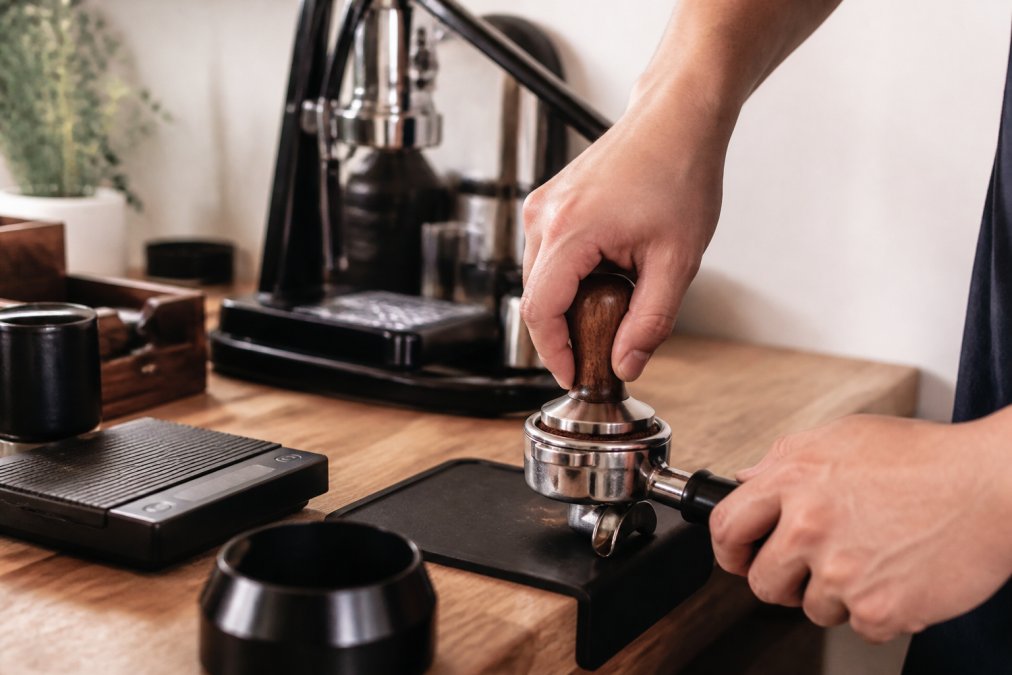
The variables you are managing all at once:
- Grind size, which controls flow rate and extraction speed
- Dose, weighed to the tenth of a gram
- Tamping pressure, applied level and consistent
- Pre-infusion, the gentle wetting of the puck before full pressure
- Pressure profile, how hard and how long you push
A common mistake is changing three variables at once when a shot tastes off. Change one, taste, repeat. That discipline is what separates people who dial in a machine in a week from people who fight it for a month.
Cost Breakdown: What You Actually Pay Upfront and Over Time
The upfront cost of a manual machine is often lower than a comparable semi-automatic, but the real number includes the grinder, the scale, and the coffee itself. A capable espresso grinder frequently costs as much as an entry-level machine, and it matters more to shot quality than the machine does.
Where the math gets interesting is the bean side. If you are pulling two double shots a day, you will go through roughly a pound of coffee every ten to fourteen days (peer-reviewed research). Gospel and Grind roasts to order and ships direct, so a bag like the 6 Bean Blend at $23.99 arrives fresh rather than sitting on a shelf for weeks. Fresh beans behave predictably in the basket, which shortens your learning curve and cuts the number of sink shots.

Physical Effort, Water Temperature, and Workflow: What Competitors Skip
Most buying guides describe manual espresso as "hands-on" and move on. That glosses over the two factors that most often decide whether a lever machine stays on your counter or ends up on a resale listing: the physical demand of pulling a shot, and the thermal behavior of a machine with no pump and often no boiler.
The physical side, honestly
Manual machines split into two broad families, and the effort differs sharply between them:
- Direct lever machines (the classic spring-and-piston design) require you to hold downward force on the lever for the full duration of the shot, typically 25 to 35 seconds. You are the pressure source, and you feel it in your shoulder, forearm, and wrist.
- Spring lever machines let a compressed spring supply the declining pressure profile. You cock the lever, then release. The spring does the work; you mostly guide it. This is meaningfully easier on the body and is the design many people with limited grip strength gravitate toward.
- Pump-assisted manuals (hand-pump or hybrid designs) shift the effort to a smaller, repeated motion rather than one sustained push.
A common pattern among owners is that the first shot of the day feels fine and the fourth feels like a workout. If you pull multiple shots back-to-back for a household, sustained-force designs get tiring fast. Ergonomics matter here in ways they never do on a pump machine: counter height, whether you can brace your body, and whether the lever travel forces you into an awkward reach all change the experience.
This is also an accessibility issue that almost no guide addresses. Anyone with shoulder, wrist, or grip limitations, or anyone shorter than the counter is designed for, should test a spring lever or pump-assisted design before committing to a direct lever. It is not a knock on the machine; it is a fit question.
Why temperature stability is genuinely hard on a manual
On a pump machine, a PID controller holds the boiler at a target temperature and the group head stays close to it. On many manual machines, there is no boiler at all, you heat water separately and pour it into the group, or you rely on a small integrated heater with limited thermal mass. That creates three specific problems:
- The group head acts as a heat sink. Cold metal pulls heat out of your water the moment it enters. If the group is not preheated, your brew temperature drops several degrees below target before extraction even begins.
- Back-to-back shots drift. The first shot warms the group; the second shot starts from a hotter group and can extract differently, often faster and more bitter. Managing that cycle deliberately (sometimes called temperature surfing) becomes part of your routine, not an optional refinement.
- Ambient conditions matter. A cold kitchen in winter versus a warm one in summer changes how quickly the group loses heat, so a grind setting that worked in July may need a small adjustment in January.
The practical fix is preheating discipline: run hot water through the group, or pull a throwaway warming shot, before the shot you actually intend to drink. Owners who skip this step often blame their beans or their grind when the real variable was temperature.
The real time cost
Time-to-shot is where the ritual either fits your morning or does not. A realistic accounting, cold start to clean counter:
- Manual: roughly 6 to 10 minutes including heat-up and preheat, plus 2 to 3 minutes of cleanup
- Semi-automatic: roughly 4 to 7 minutes including warm-up, plus 1 to 2 minutes of cleanup
- Super-automatic: under 2 minutes, with minimal cleanup
The gap is not the pull itself, it is the preheat, the dial-in check, and the wipe-down. If your mornings are tight, that 8 to 13 minute total is the number to weigh, not the 30-second extraction.
Best Manual Espresso Machine for Beginners: What to Look For
The best manual espresso machine for beginners is one with forgiving temperature behavior, a pressure gauge, and a parts supply you can actually order from. Skip anything that hides the variables you are trying to learn.
Your shortlist criteria:
- Pressure gauge or profiling feedback, so you can see what you did
- Stable group head, which holds temperature between shots
- Standard 58mm or 51mm portafilter, for accessory availability
- Replaceable gaskets and seals, because you will service this machine
- A community of owners, which is your real troubleshooting resource
If you are coming from a pod machine, expect the first month to feel like work. If you are coming from a semi-automatic, expect a shorter ramp because you already understand grind and dose.
Resale Value, Longevity, and the Beans That Make It Worthwhile
Why manual machines hold value
The "worth it" math changes once you look past year one. Manual machines are mechanically simpler than pump or super-automatic machines: no pump to fail, minimal electronics, and a group and lever assembly that is designed to be serviced rather than replaced. That simplicity is the entire durability story.
A well-maintained lever machine can plausibly run for a decade or more, and the wear items, gaskets, seals, sometimes a spring, are inexpensive and replaceable. Compare that to a super-automatic, where a failed pump, grinder, or control board can cost a meaningful fraction of the machine's original price to repair, and where the electronics date the machine quickly.
The resale consequence is real: used manual and lever machines tend to hold a larger share of their original price than used super-automatics, because the buyer knows the machine is serviceable and the design has not been obsoleted by a firmware update. A manual machine is closer to a buy-it-for-life purchase than almost anything else on the counter.
Maintenance cadence that protects that value
Longevity is not automatic, it is earned through a simple routine:
- After every session: flush the group and wipe the basket and portafilter.
- Weekly: backflush if your machine supports it, and check that the dispersion screen is clear.
- Every few months: inspect gaskets and seals for hardening or cracking; replace at the first sign of wear rather than waiting for a leak.
- Annually (or per your water hardness): descale. Hard water is the single biggest killer of espresso machines, so if your tap water is mineral-heavy, use filtered or softened water from day one.
A machine with a documented maintenance history sells for more and pulls better shots the whole time you own it. Skipping descaling is the fastest way to turn a durable machine into a paperweight.
The beans are the other half of the ROI
Here is the part that ties the whole decision together: a manual machine amplifies whatever you feed it. Good beans reward the control you paid for; stale beans make every shot taste like a technique problem when it is actually a freshness problem.
Because manual brewing already asks for your time, the beans should not add friction. Buying smaller quantities more often, checking the roast date, and storing beans away from light, heat, and air keeps the freshness variable off your list of things to fight. A medium-dark blend tends to be more forgiving while you are still learning, since it extracts more evenly across a wider range of grind settings than a very light roast.
The bottom-line ROI case
Add it up: lower upfront cost than a comparable semi-automatic, minimal and cheap service parts, a long service life, and strong resale if you ever sell. The manual machine's case is not that it is cheaper on day one, it is that it is cheaper across the years you own it, provided you keep up with basic maintenance and feed it fresh coffee.
Frequently Asked Questions
Are manual espresso machines better than automatic ones?
Not universally. Manual machines offer greater control over pressure profiling and pre-infusion, which can produce more complex flavors when you learn to use them. Automatic machines deliver consistency with less effort. For a home barista who wants hands-on experience and is willing to practice, a manual machine often wins on shot quality and durability. For someone who prioritizes speed and repeatability without a learning curve, automatic is the better fit.
Is a manual espresso machine difficult for beginners to learn?
It has a learning curve, but most beginners pull drinkable shots within a week of daily practice. The hardest parts are dialing in grind size and mastering consistent tamping pressure. Start with a machine that has a pressure gauge and a forgiving group head. Pair it with freshly roasted beans from a roaster like Gospel and Grind, because stale coffee makes learning far harder regardless of your technique.
What is the 30-second rule for espresso extraction?
The 30-second rule is a guideline, not a law. It suggests a double shot should take about 25 to 30 seconds from the moment you start the pump until you reach roughly 2 ounces of espresso. If it runs faster, your grind is too coarse. If it runs slower, your grind is too fine. Use it as a starting point, then adjust to taste. Some coffees taste best at 22 seconds, others at 35.
How does a manual lever machine affect the flavor profile of coffee?
Manual lever machines let you control pre-infusion and pressure throughout the shot. You can start with a gentle pre-infusion to saturate the puck evenly, then ramp up pressure for a rich, syrupy extraction. This often highlights sweetness and body while reducing harsh bitterness. The result is a shot with more clarity and complexity than many automatic machines produce, especially with single-origin beans like Gospel and Grind's Colombia or Bali Blue.
What equipment do I need alongside a manual espresso machine?
At minimum, you need a burr grinder, a scale accurate to 0.1 grams, a tamper that fits your portafilter, and fresh coffee beans. A distribution tool and a knock box make life easier. For milk drinks, add a pitcher and a steam wand if your machine does not include one. Budget for a quality grinder, as it affects shot consistency more than the machine itself.