

Best Coffee Scales for Precise Brewing in 2026
Table of Contents
- Why a Coffee Scale Beats Scoops and Eyeballing
- How to Choose the Best Coffee Scales for Your Brewing Method
- Coffee to Water Ratio Chart: The Numbers That Decide Your Cup
- How to Use a Coffee Scale for Pour Over Without Overthinking It
- Top Picks: Best Overall, Budget, Espresso, and Pour-Over Scales
- Water Resistance, Battery Life, and Calibration: What Most Guides Skip
- Conclusion: Match the Scale to Your Brew, Not the Hype
- Frequently Asked Questions
Last Updated: October 1, 2026
Why a Coffee Scale Beats Scoops and Eyeballing
A coffee scale is the single most impactful upgrade you can make to a home brewing setup, because it turns a guessing game into a repeatable process. At Gospel and Grind, we roast beans to order so every batch arrives at peak flavor, and that freshness deserves better than a plastic scoop. The problem with scoops is simple: bean size, density, and roast level all change how much coffee fits in one.
How to Choose the Best Coffee Scales for Your Brewing Method
The right scale depends on how you brew, not on how much you spend. Espresso demands speed and a tiny footprint; pour-over rewards a wider platform and a steady, readable display. Match those two priorities first, then everything else falls into place.
Accuracy, Resolution, and Response Time
Resolution is the smallest increment a scale can display, and for coffee you want 0.1-gram increments at minimum. Accuracy is how close that reading is to the true weight; a scale can be precise in its increments and still drift over time. Response time matters most for espresso, where a slow display can lag behind a fast extraction. Look for a scale that updates in under a second so the numbers keep pace with your pour.
Footprint, Portafilter Clearance, and Ergonomics
Espresso setups live in tight spaces, so check portafilter clearance: the scale has to sit under the group head with room for a cup. A slim scale with a low profile solves this. For pour-over, a wider platform keeps the dripper stable, and a backlit display helps in a dim kitchen. Water resistance is worth prioritizing if you brew near a sink or tend to splash.
| Feature | Espresso Priority | Pour-Over Priority |
|---|---|---|
| Resolution | 0.1 g | 0.1 g |
| Response time | Under 1 second | Moderate |
| Footprint | Slim, low profile | Wider platform |
| Display | Backlit, front-facing | Large, easy-read |
| Water resistance | High | Moderate |
Coffee to Water Ratio Chart: The Numbers That Decide Your Cup
A coffee to water ratio chart gives you a starting point, and the widely used baseline is 1:15 to 1:18, meaning one gram of coffee to fifteen to eighteen grams of water. Stronger brews sit near 1:15; lighter, brighter cups sit near 1:17 or 1:18.
| Brew Method | Ratio (Coffee:Water) | Example (20 g dose) |
|---|---|---|
| Espresso | 1:2 | 20 g in, 40 g out |
| Pour-over | 1:16 | 20 g coffee, 320 g water |
| French press | 1:15 | 20 g coffee, 300 g water |
| Drip | 1:17 | 20 g coffee, 340 g water |
How to Use a Coffee Scale for Pour Over Without Overthinking It
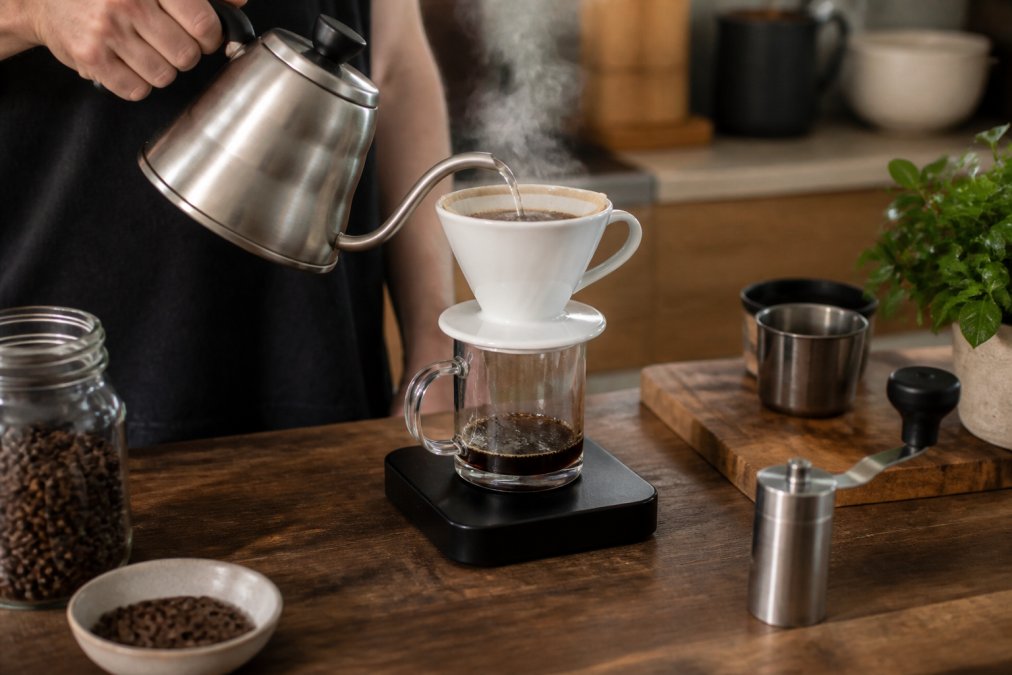
Learning how to use a coffee scale for pour over comes down to three moves: tare, dose, and pour by weight. Place your dripper and mug on the scale, press tare to zero it, then add your coffee until the display hits your target dose. Tare again, then pour water in stages while watching the weight climb. That's the whole method.
Top Picks: Best Overall, Budget, Espresso, and Pour-Over Scales
Most listicles hand you a winner and move on. What they don't tell you is that the scale you buy today is the scale you'll live with for years, so the category pick matters less than whether the model survives daily use. Below, each category is framed around the trade-off that actually shows up after six months, not on unboxing day.
Best Overall
The all-around pick needs 0.1-gram resolution, a response time fast enough to keep up with a moderate pour, and a platform wide enough to hold a dripper without wobbling. The models that consistently earn this slot, the Acaia Pearl line, the Fellow Tally Pro, and the Timemore Black Mirror Basic 2, all clear that bar. The differentiator is the display: the Pearl's LED matrix stays readable at an angle, the Tally Pro adds a brew-guide mode that counts pours for you, and the Black Mirror Basic 2 undercuts both on price while keeping the same 0.1-gram resolution.
Best Budget Pick
A budget scale should still deliver 0.1-gram increments and a tare that responds instantly. The Greater Goods Digital Kitchen Scale and the KitchenTour Coffee Scale both hit that mark for well under what a specialty scale costs, and for drip, French press, and batch brewing they are genuinely sufficient. What you give up is response speed, expect a visible lag of a few tenths of a second, and water resistance, which is usually absent at this tier.
Best for Espresso Machines
Espresso is the demanding case, and it's where the price gap between tiers is justified. You need a scale that updates fast enough to track a 25-to-30-second shot, a footprint slim enough to slide under a portafilter with a cup on top, and ideally a built-in timer that starts on first drip. The Acaia Lunar is the reference point here, it's built specifically for the group head, with a low profile and a fast refresh rate.
Best for Pour-Over Brewing
Pour-over rewards a wider platform, a large backlit display, and a comfortable viewing angle so you're not craning mid-pour. The Fellow Tally Pro and the Acaia Pearl S both fit this brief, and both add guided-brew features that walk you through bloom and pulse pours by weight. Water resistance matters more here than in espresso, because a gooseneck kettle at full tilt splashes.
Water Resistance, Battery Life, and Calibration: What Most Guides Skip
Every other guide reviews a scale the day it arrives. This one is about what happens in month eight, when the readings drift, the battery sags, and a splash finally finds the circuit board. That's the part of ownership no listicle covers, and it's the part that decides whether you're still happy with your purchase.
Calibration: The Maintenance Step Nobody Does
A load cell, the strain-gauge sensor inside every digital coffee scale, is a mechanical component, and mechanical components drift. Temperature swings, hard knocks, and simple fatigue all shift the zero point over time. The symptom is subtle: your 18-gram dose starts reading 18.3, your ratio quietly changes, and you blame the beans.
Battery Life and the Chemistry Behind It
Rechargeable scales almost universally use lithium-ion cells, and lithium-ion capacity fades with every full charge cycle. A scale that ran three weeks on a charge when new may run ten days after two years of daily use. That's normal, not a defect, and it's the single most common reason people replace an otherwise functional scale.
Water Resistance: What the Ratings Actually Mean
Water resistance is the spec most likely to be omitted from a product page, and the omission is usually telling. When a manufacturer does publish a rating, it's typically an IP number, IPX4 means splash-resistant from any direction, IPX7 means it survives brief immersion. A scale with no published rating should be treated as unprotected.
Conclusion: Match the Scale to Your Brew, Not the Hype
The best coffee scales for precise brewing aren't the most expensive ones; they're the ones matched to how you actually brew. A pour-over drinker doesn't need millisecond response, and an espresso drinker can't compromise on footprint or speed. Buy for your method, keep it calibrated, and protect it from water. That's the whole game.
Frequently Asked Questions
Which coffee scale is the most accurate?
Accuracy in coffee scales comes down to resolution and response time. A scale with 0.1-gram increments and a response time under one second gives you reliable readings for both espresso and pour-over. For espresso, you want a scale that updates in under 500 milliseconds so you can track extraction in real time. For pour-over, 0.1-gram resolution is enough to hit your target ratio consistently. Look for scales with a stated accuracy tolerance of plus or minus 0.1 grams rather than vague marketing claims.
Do I need a high-end scale for pour-over coffee?
Not necessarily. Pour-over brewing benefits from a scale with 0.1-gram resolution, a built-in timer, and a flat platform that fits your dripper. Many mid-range scales deliver all three without the cost of barista-grade espresso scales. The main difference is response speed and durability. If you only brew pour-over, a scale in the mid-range will serve you well for years. If you also pull espresso shots, investing more gets you faster readings and better portafilter clearance.
Is a waterproof coffee scale worth the extra cost?
Water resistance matters more than most people expect. Coffee brewing involves spills, steam, and rinsing, and moisture is the most common cause of scale failure. A scale rated IPX4 or higher handles splashes and wiping without issue. If you brew daily and want the scale to last, water resistance is a practical feature, not a luxury. It also makes cleaning easier since you can wipe the surface without worrying about liquid seeping into the electronics.
How does a built-in timer improve coffee brewing consistency?
A built-in timer lets you track both weight and time in one place, which matters for pour-over and espresso. In pour-over, you can follow a recipe that specifies pouring 60 grams of water by the 30-second mark. In espresso, you can watch the shot reach its target yield within a specific time window. Without a timer on the scale, you are juggling two devices and losing the connection between weight and time, which is where consistency breaks down.
Great coffee starts long before the scale. Gospel and Grind roasts carefully sourced beans to order, so what lands in your grinder is as fresh as it gets, delivered straight to your door, with every purchase helping fight homelessness one cup at a time. If you want beans worthy of a precise brew, find your perfect roast with Gospel and Grind.