

How to Brew Fresh Coffee at Home Like a Pro
Table of Contents
- Start With Freshly Roasted, Whole Bean Coffee
- The Best Water to Coffee Ratio for Consistent Results
- Coffee Grind Size Chart: Match Your Grind to Your Brewer
- How to Bloom Coffee Grounds Before You Brew
- Water Temperature and Quality: The Variables Most Brewers Skip
- How to Store Coffee Beans for Freshness
- Brewing Methods Compared: Pour-Over, French Press, and Drip
- Frequently Asked Questions
Last Updated: September 20, 2026
Start With Freshly Roasted, Whole Bean Coffee
The single biggest upgrade to your home cup isn't a gadget. It's the calendar. If you want to know how to brew fresh coffee at home like a pro, start by buying coffee with a recent roast date, and buy it whole bean. This guide from Gospel and Grind walks through the variables that actually change what lands in your mug.
Freshly roasted coffee is coffee that has rested long enough to release trapped gases but not so long that its aromatics have faded. Most roasters agree the sweet spot sits roughly four days to four weeks after the roast date, which is why Specialty Coffee Association guidance on coffee freshness treats roast date, not a best-by stamp, as the number that matters.
Why Roast Date Beats Best-By Date
A best-by date tells you when a package stops being sellable. A roast date tells you when the coffee peaked. Those are different questions, and only one of them helps you brew a better cup.
Coffee begins losing aromatics the moment it leaves the roaster. Whole beans slow that decline because the oils stay protected inside the bean. Ground coffee exposes far more surface area to oxygen, so it stales dramatically faster.
What most guides miss is that "fresh" has a ceiling, too. Coffee roasted yesterday and brewed today often tastes flat and gassy because it's still releasing carbon dioxide. Give it a few days to settle.
The Best Water to Coffee Ratio for Consistent Results
The best water to coffee ratio for most brewers is 1:15 to 1:17 by weight, meaning one gram of coffee to roughly 15 to 17 grams of water. Start at 1:16 and adjust from there.
That range is a starting point, not a rule. A darker roast usually tastes better slightly stronger, while a light single-origin often opens up with more water. The variable that matters more than the exact number is consistency. Pick a ratio, hold it steady, and change only one thing at a time.
How to Measure by Weight, Not Scoops
A scoop is a volume measurement, and coffee density varies wildly. A scoop of a dense medium roast can weigh noticeably more than a scoop of a light, chaffy one. If you switch beans and keep the same scoop, your ratio silently drifts.
A kitchen scale fixes this for a few dollars. Weigh your coffee, weigh your water, and you've removed the largest source of day-to-day inconsistency in home brewing. This is the cheapest pro habit you can adopt.
| Ratio | Coffee (per 12 oz water) | Best For |
|---|---|---|
| 1:15 | 24 g | Dark roasts, immersion brewing |
| 1:16 | 22 g | Balanced everyday starting point |
| 1:17 | 21 g | Light roasts, pour-over clarity |
Coffee Grind Size Chart: Match Your Grind to Your Brewer
The right grind size depends entirely on how long water contacts the coffee. Faster brewing methods need finer grounds; slower methods need coarser ones. Here's the coffee grind size chart most home brewers can work from:
| Brewer | Grind Size | Brew Time |
|---|---|---|
| Espresso | Fine | 25-30 seconds |
| Aeropress | Fine to medium-fine | 1-2 minutes |
| Drip machine | Medium | 4-6 minutes |
| Pour-over | Medium | 3-4 minutes |
| French press | Coarse | 4 minutes steep |
Grind consistency matters as much as grind size.
Why a Burr Grinder Beats a Blade Grinder
A burr grinder crushes beans between two surfaces set to a fixed distance, producing uniform particles. A blade grinder chops them into random sizes. That difference shows up directly in the cup.
How to Bloom Coffee Grounds Before You Brew
Blooming is the step where you pour a small amount of hot water over the grounds and wait before brewing in earnest. It releases trapped carbon dioxide so water can extract flavor evenly instead of fighting through a gas barrier.
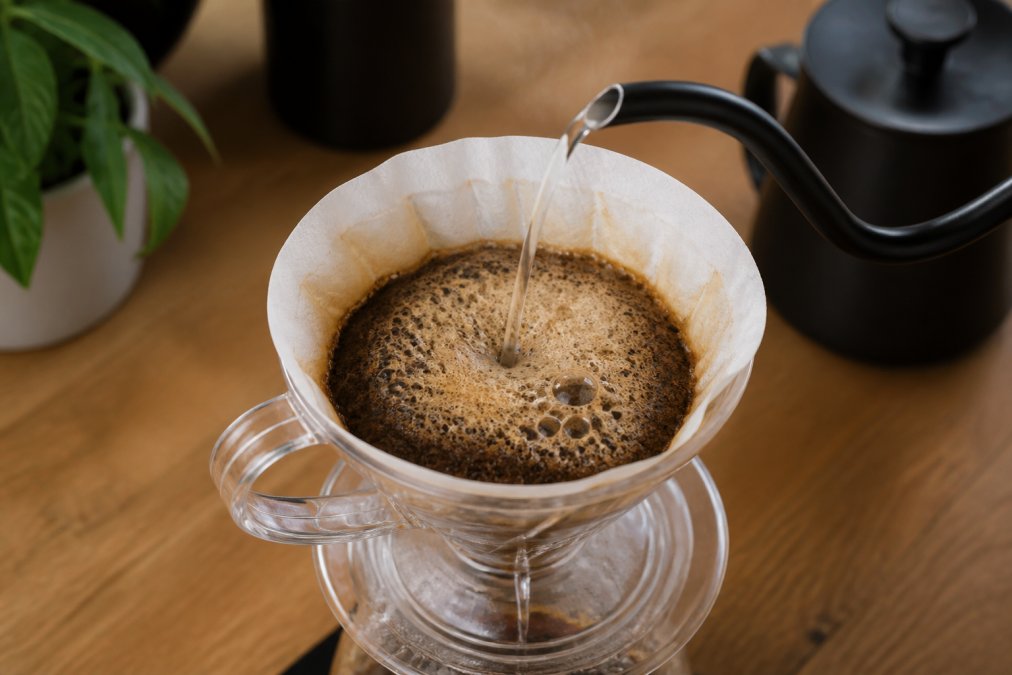
Here's how to bloom coffee grounds properly:
- Add your ground coffee to the brewer.
- Pour roughly twice the coffee's weight in hot water, just enough to saturate the grounds.
- Wait 30 to 45 seconds. You'll see the bed swell and bubble as gas escapes.
- Continue with your normal brew once the bubbling slows.
Water Temperature and Quality: The Variables Most Brewers Skip
Water temperature should sit between 195°F and 205°F for most brewing methods. Below that range, extraction stalls and the cup tastes weak and sour. Above it, you scorch the grounds and pull out harsh, bitter compounds. A gooseneck kettle with a built-in thermometer removes the guesswork; if you're using a stovetop kettle, let it sit 30 to 45 seconds off the boil before pouring.
What Minerals Actually Do During Extraction
The two minerals that matter most are magnesium and calcium. Both are positively charged ions that bind to the negatively charged flavor compounds in coffee grounds and pull them into the water. Magnesium binds more aggressively than calcium, which is why water with a higher magnesium-to-calcium ratio tends to produce brighter, more fruit-forward cups. Calcium supports body and sweetness but can also drive bitterness if it runs high.
Reading Your Own Water
If your tap water tastes good straight from the glass, it will usually brew decent coffee. If it tastes like chlorine, sulfur, or pool water, that will land in your cup. A simple carbon filter pitcher removes chlorine and most off-flavors without stripping the minerals you want. Reverse osmosis and distillation remove nearly everything, which is why straight distilled water brews a flat, hollow cup, there's nothing left to carry flavor compounds out of the grounds.
How to Store Coffee Beans for Freshness
Store coffee beans in an airtight, opaque container at room temperature, away from light, heat, and moisture. That's the whole answer, and most storage advice beyond it is marketing.
Brewing Methods Compared: Pour-Over, French Press, and Drip
Each brewing method trades control against convenience, and the right pick depends on your morning. Pour-over gives you the most control over extraction. French press delivers full body with minimal fuss. Drip machines win on repeatability when you're rushed.
| Method | Grind | Time | Strength | Best For |
|---|---|---|---|---|
| Pour-over | Medium | 3-4 min | Light, clear | Flavor detail |
| French press | Coarse | 4 min | Full body | Rich, heavy cups |
| Drip | Medium | 4-6 min | Medium | Busy mornings |
Pour-Over: The Control Method
A pour-over is a series of timed pours through a paper filter. The paper traps oils and fine particles, which is why the cup reads cleaner and more transparent than immersion methods. A gooseneck kettle is not optional here, a wide spout dumps water in unevenly and channels through the bed, leaving dry patches that never extract.
French Press: The Immersion Method
French press is full immersion with a metal mesh filter, so oils and fine particles stay in the cup. That's where the heavy body comes from, and also why the last sip can taste muddy if you pour too aggressively.
Drip: The Repeatability Method
A drip machine automates the pour, which is exactly why it's the easiest method to make consistent. The trade-off is that cheap machines run too cool and distribute water unevenly. Look for one that hits at least 195°F and carries a certification from the Specialty Coffee Association, which tests for temperature stability and even saturation.
Frequently Asked Questions
What is the 15-15-15 rule for coffee?
The 15-15-15 rule is a simple brewing guideline: use a 1:15 coffee-to-water ratio, aim for a 15% extraction yield, and keep total brew time around 15 minutes for cold brew. For hot methods, the ratio and extraction numbers still apply, but brew time drops to 2-4 minutes. Weigh 15 grams of coffee to 225 grams of water as a starting point, then adjust to taste.
Does water temperature affect coffee extraction?
Temperature directly controls how fast water pulls flavor from grounds. The Specialty Coffee Association recommends 195-205°F for brewing. Water below 195°F under-extracts, leaving coffee sour and thin. Above 205°F over-extracts, producing bitterness. A gooseneck kettle with a built-in thermometer removes the guesswork, and letting a kettle rest 30 seconds after boiling gets you into the right range.
Why is freshly roasted coffee better for brewing?
Coffee releases carbon dioxide for 4-14 days after roasting, a process called degassing. Beans roasted within the last two weeks still hold volatile aromatic compounds that create sweetness and complexity in the cup. After that window, oxidation dulls the flavor and the coffee tastes flat. Buying from a roaster that ships within days of roasting, like Gospel and Grind's roasted-to-order model, keeps you inside that fresh window.
How many scoops of coffee should I put in a coffee maker?
Scoops vary in size, so weight is more reliable. A standard starting point is 1 to 2 tablespoons of ground coffee per 6 ounces of water, which lands near a 1:16 ratio. For a 12-cup drip machine, that's roughly 60-70 grams of coffee. Use a kitchen scale to hit the best water to coffee ratio consistently, then adjust finer or coarser depending on how the cup tastes.
Brewing like a pro comes down to controlling a handful of variables: fresh whole beans, a consistent ratio, the right grind, and water that's hot enough and mineral-balanced. Nail those and the method matters far less than you'd think. Gospel and Grind roasts to order so your beans arrive at peak flavor, offers blends, single-origin selections, and sample packs, and delivers straight to your door. Find your perfect roast and start every morning with a cup worth the effort.