

Is Gourmet Coffee Delivery Worth the Price? 2026 Review
Table of Contents
- How Gourmet Coffee Delivery Works
- The Cost of Specialty Coffee Subscriptions
- Fresh Roasted Coffee Beans Subscription: Why Roast Date Matters
- How to Choose a Coffee Subscription That Fits Your Routine
- Pros and Cons of Gourmet Coffee Delivery
- Trying Before You Commit: Sample Packs and Trial Offers
- Frequently Asked Questions
Last Updated: September 13, 2026
How Gourmet Coffee Delivery Works
Gourmet coffee delivery is a subscription or one-time service that ships freshly roasted specialty coffee beans directly from a roaster to your door, typically within days of the roast date rather than months. This guide breaks down the real costs, freshness factors, and hidden fees so you can decide whether it fits your routine.
The model is simple on the surface: you pick a frequency, a roast preference, and a grind setting, then the roaster ships on a recurring schedule. What separates a good service from a disappointing one is what happens between the roaster and your doorstep.
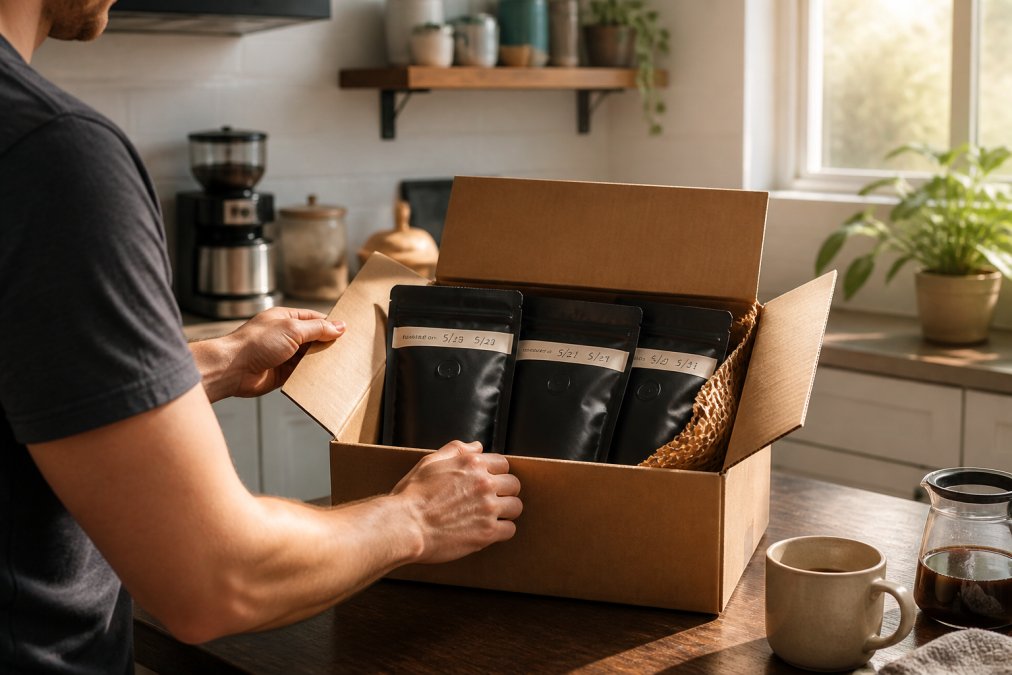
From Roaster to Doorstep
Gospel and Grind operates on a roast-to-order basis, meaning your beans are roasted after you place the order, not pulled from a warehouse shelf. Shipping typically happens within one to three business days of roasting. The gap between roast date and your first cup is the single biggest factor in flavor, and it is the main thing grocery store bags cannot match.
What Arrives in a Typical Box
A standard shipment includes whole bean or ground coffee in a valve-sealed bag, often with the roast date printed on the label. Gospel and Grind offers a curated selection of single-origin offerings. Sample packs let you test several roasts before committing to a full-size bag.
The Cost of Specialty Coffee Subscriptions
The cost of specialty coffee subscriptions varies widely by roast quality, volume, and shipping frequency. Most services land in a range that looks higher than grocery store pricing per bag, but the comparison only becomes meaningful once you break it down to cost-per-cup and factor in how much of each bag you actually drink.
Cost-Per-Cup vs. Grocery Store Bags
A 12-ounce bag of specialty coffee typically brews around 16 to 20 cups, depending on your brewing method and dose. A standard drip dose is about 0.36 ounces of ground coffee per 6-ounce cup, so a 12-ounce bag yields roughly 33 cups at that strength; a stronger pour-over dose of 0.7 ounces per cup drops that to about 17 cups (ncausa.org). That spread is why cost-per-cup comparisons go wrong so often, two people brewing from the same bag can land on very different numbers.
Grocery store bags often cost less upfront, but they are frequently roasted months before purchase, which means you may be paying for stale beans that produce a flat cup. Subscription coffee costs more per bag but delivers a fresher product with a longer usable window after opening. The table below frames the trade-off on the variables that actually move your monthly spend.
| Factor | Grocery Store Bags | Gourmet Delivery |
|---|---|---|
| Typical roast age | Weeks to months | Days |
| Cost per bag | Lower | Higher |
| Cost per cup | Lower upfront | Higher but fresher |
| Flavor consistency | Variable | Consistent |
| Convenience | Trip required | Delivered |
| Waste risk | High if bag goes stale | Lower if frequency is matched |
The Break-Even Math You Should Run Before Subscribing
Before you compare a subscription to your grocery run, calculate three numbers: your daily cup count, your dose per cup, and your monthly coffee budget. A household brewing two 10-ounce mugs per day at roughly 0.6 ounces of coffee per mug consumes about 36 ounces of beans per month, three 12-ounce bags. If your subscription ships two bags every four weeks, you are under-supplied; if it ships four, you are accumulating a surplus that will stale before you reach it.
The break-even point against grocery store coffee is not about matching the bag price. It is about how many of those bags you finish while the beans are still at peak flavor. A cheaper bag that you pour out half of costs more per good cup than a pricier bag you finish completely.
A Simple Consumption Calculator
Use this five-step method to size a plan before you commit:
- Count your cups. Track every cup you brew for seven days, including weekends. Most people overestimate weekday consumption and underestimate weekend consumption.
- Convert to ounces. Multiply cups by your dose per cup. A 6-ounce drip cup uses about 0.36 ounces; a 10-ounce mug uses about 0.6 ounces; a 12-ounce pour-over uses about 0.75 ounces.
- Multiply by 30. That is your monthly bean need in ounces.
- Divide by bag size. A 12-ounce bag covers about one-third of a month for a two-mug-per-day household.
- Round down, not up. Choose the plan that ships slightly less than you calculated. You can always add a one-time bag; you cannot un-stale a surplus.
A common pattern is that households drinking one cup per day are better served by a single 12-ounce bag every four to six weeks, while two-cup households need two to three bags per month. Matching that number is the single biggest lever on whether a subscription feels worth it.
Where the Value Actually Comes From
The premium you pay for gourmet delivery buys three things: a known roast date, a shorter time between roast and brew, and access to single-origin coffees that rarely reach grocery shelves. If you drink coffee primarily for caffeine and are indifferent to flavor nuance, that premium is hard to justify. If you drink coffee for the cup itself, the freshness premium is the product, not an add-on.
Fresh Roasted Coffee Beans Subscription: Why Roast Date Matters
A fresh roasted coffee beans subscription wins on one variable that no grocery shelf can match: time since roast. Coffee begins losing aromatic compounds within days of roasting, and the decline accelerates once the bag is opened and exposed to oxygen.
Storing Beans for Peak Flavor
Store whole beans in an airtight container away from light, heat, and moisture (ncausa.org). Grind immediately before brewing.
Buying a large bulk bag to "save money" backfires if you cannot finish it within a few weeks. The last third of that bag will taste noticeably flatter than the first, and many people end up discarding it.
How to Choose a Coffee Subscription That Fits Your Routine
Choosing a coffee subscription comes down to matching shipping frequency and volume to your actual consumption rate, not your ideal one. Overestimating how much you drink is the most common reason people cancel.
Questions to Ask Before You Commit
- How many cups do you brew on a typical weekday versus a weekend?
- Do you want whole bean, ground coffee, or single-serve capsules?
- Can you pause or skip a shipment when you travel?
- Is there a trial offer or sample pack to test before a full commitment?
- What is the cancellation policy, and are there fees?
Pros and Cons of Gourmet Coffee Delivery
Gourmet coffee delivery delivers clear advantages in freshness and convenience, but it also carries costs that do not show up on the bag price. Understanding both sides, and the landed cost of each shipment, prevents buyer's remorse.

Pros:
- Fresher beans with a known roast date
- Convenience of automated delivery
- Access to single-origin and small-lot coffees
- Customizable preferences for grind and roast
- Predictable monthly spend if frequency is matched to consumption
Cons:
- Higher upfront cost per bag
- Recurring billing can outpace consumption
- Shipping adds to the total cost
- Limited flexibility if your routine changes mid-cycle
- Packaging waste accumulates with frequent small shipments
The Hidden Costs Beyond the Bag Price
The sticker price on a subscription bag is rarely the price you pay. The landed cost of a shipment includes several line items that product pages do not surface until checkout:
- Shipping fees.
- Sales tax (irs.gov). Applied at checkout based on your state and the roaster's nexus. On a $20 bag with $6 shipping, tax on the combined total adds another dollar or so.
- The convenience tax. The gap between what you pay delivered and what you would pay picking up the same beans at a local roaster. For many households that gap is $4 to $10 per bag. That is the real price of not leaving the house.
- Waste cost. Every bag you do not finish before it stales is money spent on coffee you poured out. A single wasted 12-ounce bag per month can erase the entire freshness premium you were paying for.
- Packaging. Valve-sealed bags, boxes, and sometimes ice packs or inserts. Not a dollar cost, but a recurring disposal cost.
Tracking your consumption rate for two weeks before subscribing is the simplest way to avoid the waste line item. The other four are fixed and predictable, read the shipping policy and tax note before you commit, not after.
Environmental Footprint of Shipping
Every shipment carries a delivery footprint, and frequent small orders compound it. A single 12-ounce bag shipped alone travels the same last-mile route as a three-bag order, but delivers one-third the coffee, so the emissions per pound of coffee are roughly three times higher. Consolidating shipments and choosing a frequency that matches your consumption reduces both waste and the number of trips required to get coffee to your door.
The comparison against grocery store coffee is not as one-sided as it looks. Grocery beans travel by truck in bulk, which is efficient per pound, but they also pass through warehouses and sit on shelves for weeks or months, inventory that ties up energy and shelf space. A direct-from-roaster shipment skips the warehouse stage entirely.
A practical rule: order the largest volume you can finish before the beans stale, not the smallest volume that ships free. That single choice cuts both your cost-per-cup and your shipping footprint.
Trying Before You Commit: Sample Packs and Trial Offers
Sample packs are the lowest-risk way to test a roaster before committing to recurring billing. They let you compare flavor profiles and confirm the roast date meets your expectations.
At Gospel and Grind, the Best Sellers Sample Pack includes six 2-ounce packs for $20.89, covering a dark roast house blend, a medium-dark Cowboy Blend, a Breakfast Blend, and single-origin offerings from Peru, Mexico, and Bali. If you prefer lighter, brighter cups, the Single Origin Favorites Sample Pack at $20.89 spans Brazil Santos. For flavored coffee drinkers, the Flavored Coffees Sample Pack at $20.89 covers French Vanilla.


If you want to skip the brewing setup entirely, the 12 Pack Single Serve Coffee Capsules run $16.99, and the 60 Pack Single Serve Coffee Capsules run $56.99. Each coffee capsule is sealed with no oxygen inside (no air) so the coffee stays fresh. An improved filter design stops coffee from shooting right through the middle, absorbing more grounds for a lively cup, without slowing down the brew time.
The hardest part of gourmet coffee delivery is not finding a roaster, it is matching the plan to how you actually drink. Get that wrong and even excellent beans become waste. Gospel and Grind roasts to order for maximum flavor and aroma, sources beans from trusted farms, and delivers directly to your door, with every purchase supporting the fight against homelessness. Start with a sample pack, confirm your consumption rate, then build a subscription around it. Find your perfect roast with Gospel and Grind.
Frequently Asked Questions
How much does a gourmet coffee subscription cost per month?
Costs vary by roaster and frequency, but most gourmet coffee delivery services charge between $15 and $30 per bag. Gospel and Grind offers sample packs at $20.89 and single-serve capsules starting at $16.99, so you can test before committing to a recurring plan. Your monthly total depends on how many bags you order and how often they ship.
Is it cheaper to buy coffee beans online or at the store?
Grocery store beans often cost less per bag, but the gap narrows when you calculate cost-per-cup. Stale beans require more grounds to brew a flavorful cup, while freshly roasted beans from a subscription deliver consistent extraction.
What are the benefits of fresh roasted coffee beans subscriptions?
The main benefit is roast date transparency. Beans peak in flavor between 4 and 14 days after roasting, and grocery store bags often sit for weeks. A fresh roasted coffee beans subscription ships shortly after roasting, so you get brighter tasting notes, less staleness, and a more consistent brew. You also avoid last-minute store runs and can explore single-origin offerings you would not find locally.
How do I know if a coffee subscription is high quality?
Look for a visible roast date on the bag, not just a best-by date. Check whether the roaster names the farm, region, and processing method. Tasting notes should be specific rather than generic. Sample packs from Gospel and Grind let you try six different coffees for $20.89, which is a low-risk way to judge quality before committing to a full subscription.
What should I look for in a premium coffee delivery service?
Prioritize roast-to-order production, flexible shipping frequency, and clear cancellation terms. A good service lets you pause deliveries when you travel and adjust grind size for your brewing method. Check whether the brand shares sourcing details and whether the price includes shipping. Ethical sourcing and mission-driven practices, like supporting homelessness initiatives, add value for conscious buyers.