

Best Manual Coffee Grinders for Home Brewing in 2026
Table of Contents
- What Separates the Best Manual Coffee Grinders for Home Brewing
- Quick Comparison: Top Manual Coffee Grinders at a Glance
- Manual vs Electric Coffee Grinder: Which Fits Your Routine
- Manual Coffee Grinder Settings for French Press and Other Brew Methods
- How to Clean a Manual Coffee Grinder (and Keep It Grinding Years Longer)
- Torque, Effort, and Ergonomics: What Daily Grinding Actually Feels Like
- Replacement Parts and Long-Term Wear: What to Check Before You Buy
- How to Choose the Right Manual Coffee Grinder for Your Kitchen
- Frequently Asked Questions
Last Updated: October 2, 2026
What Separates the Best Manual Coffee Grinders for Home Brewing
A manual coffee grinder is a hand-powered mill that crushes roasted beans between two burrs, giving you control over particle size without electricity. The best manual coffee grinders for home brewing share three traits: conical burr sets, stable bearings, and repeatable adjustment. A great roast deserves a grinder that treats it well.
Burr quality decides most of the outcome. Blade grinders chop; burrs crush. That difference shows up in the cup.
Burr Type and Grind Consistency
Conical burr sets produce a more even particle size distribution than flat blades or cheap ceramic knockoffs. Grind consistency determines how evenly water extracts flavor.
Stainless steel burrs hold an edge longer than ceramic. Ceramic stays sharper at first but chips under stress.
Burr alignment matters as much as burr material: a misaligned set creates inconsistent grinds no matter how much you paid.
Quick Comparison: Top Manual Coffee Grinders at a Glance
| Grinder Type | Burr Material | Adjustment | Best For |
|---|---|---|---|
| Entry hand grinder | Hardened steel | Click-based, 15-25 steps | Beginners, drip coffee |
| Mid-range hand grinder | Stainless steel conical | Stepless or 30+ clicks | Pour-over, Aeropress |
| Premium hand grinder | Coated stainless steel | Stepless with micron marks | Espresso fine, single-dose |
| Travel grinder | Ceramic or steel | Limited clicks | Portability, French press |
This table maps categories, not brands. The right pick depends on your brew method and how much torque you'll produce each morning.
Manual vs Electric Coffee Grinder: Which Fits Your Routine
Manual grinders win on cost, noise, and portability. Electric grinders win on speed and consistency at volume.
A manual vs electric coffee grinder comparison usually ignores effort. Grinding 20 grams for a pour-over takes roughly 30 to 60 seconds by hand with a decent burr set; espresso fine takes longer and demands more torque, and two double shots daily will make your wrist notice.
Electric models handle repeatability better. Set the dial, press the button, done. Manual grinders ask you to count clicks and stay consistent.
The honest trade-off: manual grinders give you control and silence at the cost of physical effort; electric gives you speed at the cost of counter space, noise, and usually money.
Manual Coffee Grinder Settings for French Press and Other Brew Methods
Manual coffee grinder settings for French press land in the coarse range, roughly 800 to 1,000 microns.
Different brew methods need different particle sizes:
- French press: Coarse grind, 30-40 clicks on a typical click-based grinder
- Drip coffee: Medium grind, 20-25 clicks
- Pour-over: Medium-fine, 15-20 clicks
- Aeropress: Fine to medium-fine, 10-15 clicks
- Moka pot: Fine, 8-12 clicks
- Espresso: Espresso fine, 3-8 clicks depending on the burr set
- Cold brew: Coarse grind, same range as French press
Stepless adjustment gives you finer control between clicks. Click-based settings are easier to repeat. Neither is better; they suit different temperaments.
Calibration drifts over time. Recalibrate every few months by finding your grinder's true zero point, where the burrs touch, and counting from there.
How to Clean a Manual Coffee Grinder (and Keep It Grinding Years Longer)
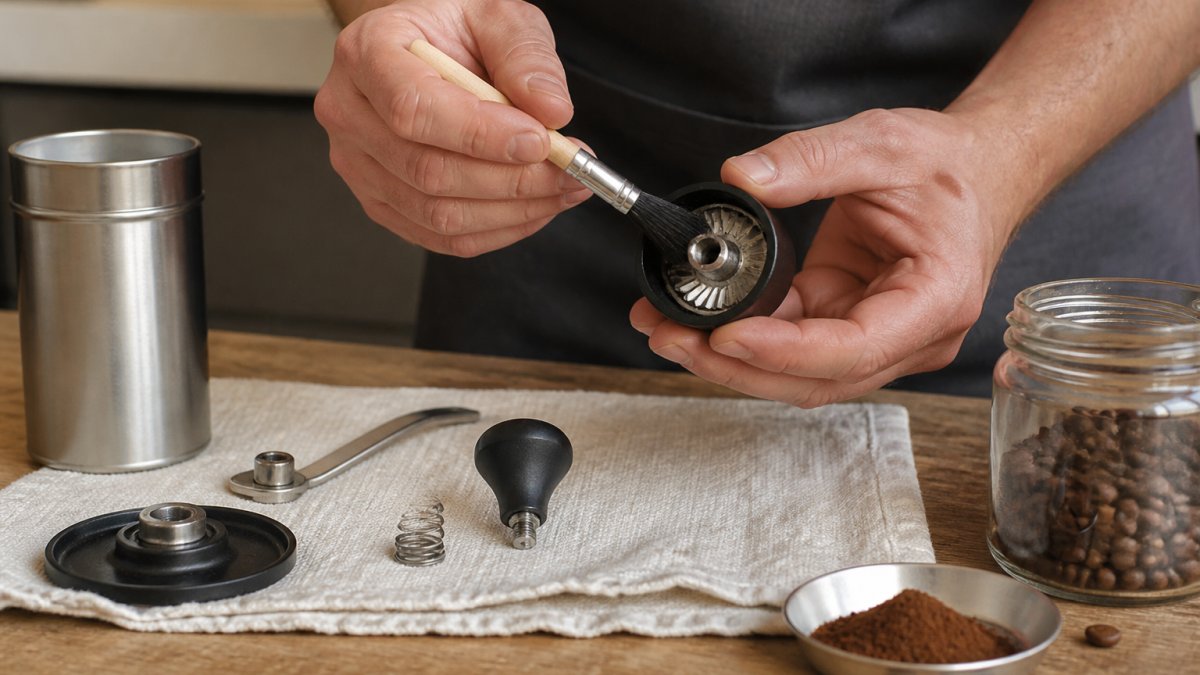
Cleaning a manual coffee grinder takes five minutes and prevents most long-term problems. Old grounds go stale, clog burrs, and add off-flavors to every fresh batch.
- Empty the bean chamber and grind out any remaining beans
- Disassemble the grinder following the manufacturer's instructions
- Brush the burrs with the cleaning brush that came with the unit
- Wipe the burr chamber with a dry cloth; never rinse steel burrs with water
- Reassemble and run a small handful of beans through to clear residue
Do this weekly for daily use. Deep-clean monthly.
Static reduction matters here: dry winter air makes grounds cling to burrs and the catch cup, and a few drops of water on beans before grinding cuts static noticeably.
Torque, Effort, and Ergonomics: What Daily Grinding Actually Feels Like
Torque requirements vary wildly between grinders, and most reviews skip this entirely. A grinder that feels effortless for French press can feel like work for espresso fine, the most under-reported spec in the category, and the one that decides whether you keep using a hand grinder past week two.
Why Light Roasts Fight Back
Bean hardness is the hidden variable. Roasting drives moisture out and fractures the bean's cell structure, so a dark roast crushes with noticeably less resistance than a light roast of the same origin. A light-roast Ethiopian natural and a dark-roast Sumatra can differ enough that the same grinder feels like two different tools. If you drink light-roast single-origin espresso, expect a workout: fine settings plus hard beans is the maximum-effort combination a hand grinder can ask of you.
A common pattern among daily hand grinders is that effort scales with three inputs at once:
- Target particle size: Espresso fine requires more revolutions and more force per revolution than coarse French press.
- Bean density and roast level: Light and high-grown beans resist the burr more than dark, low-grown beans.
- Burr sharpness and geometry: A sharp, well-machined conical burr set cuts beans; a dull or misaligned set crushes them, which feels dramatically harder.
What Grinding Actually Costs You in Time and Effort
For a typical mid-range conical hand grinder, grinding 20 grams for a pour-over runs roughly 30 to 60 seconds of steady cranking. The same 20 grams at espresso fine can take two to three times as long and demands a firm grip the whole way. Two double shots a day is a real wrist commitment; one French press a day is not.
Handle design changes the felt effort more than most buyers expect:
- Handle length: A longer arm gives more leverage per turn, so the same burr set feels easier to drive.
- Grip surface: Knurled or textured grips reduce slipping when your hands are dry or when you are grinding hard beans.
- Folding handles: Great for travel, but the shorter effective arm usually means more force per revolution.
- Body diameter and bracing: A wider body is easier to brace against your palm or between your knees, which matters most at espresso settings.
How to Predict Effort Before You Buy
You cannot test-drive most hand grinders, so use these proxies:
- Burr material and geometry. Hardened steel conical burrs cut faster and feel lighter than ceramic or blade-style sets at the same setting.
- Bearing stability. A grinder with a stable shaft and tight tolerances transfers your force into cutting rather than wobble, so it feels easier and grinds more evenly.
- Adjustment range. A grinder that reaches true espresso fine will feel harder at its finest settings than one that tops out at drip, that is physics, not a defect.
- Reported grind times. When a maker or reviewer gives a seconds-per-gram figure, treat it as the closest thing to an effort spec you will get.
Grind speed also depends on burr geometry and your cadence: a well-machined conical burr set cuts faster than a dull one at the same RPM, which is why premium grinders feel easier. Effort is not a fixed property of "hand grinding", it is a function of burr quality, bean choice, and target grind, and you can steer all three.
Replacement Parts and Long-Term Wear: What to Check Before You Buy
Replacement part availability separates grinders that last a decade from grinders that become paperweights. Almost every review is an out-of-the-box impression; almost none tell you what the grinder is like after a year of daily use, so treat this as the ownership test the rest of the category skips.
The Three Wear Points That Actually Fail
Long-term wear shows up in three places, roughly in order of how often they cause problems:
- Burr edges: Dull burrs crush instead of cut, producing more fines and a wider particle spread. You will notice it first as a cup that tastes muddier and less clean at the same setting.
- Bearings: Worn bearings let the shaft wobble, which ruins burr alignment and makes grinding feel rougher and less consistent. This is the failure most likely to end a grinder's life, because it is the hardest to fix on a sealed unit.
- Handle and shaft connection: Stripped threads, a cracked handle, or a loose fitting make grinding erratic and can strip the drive shaft if ignored.
Stainless steel burrs typically hold a usable edge for years of daily home use, and ceramic burrs chip more easily but hold sharpness well when cared for. Bearings and handles tend to fail sooner than burrs, which is why parts support matters more than burr material for most buyers.
A Repairability Framework: Score Any Grinder Before You Buy
Before buying, run the grinder through these four checks. A grinder that passes all four is a long-term tool; one that fails two or more is effectively disposable.
- Are burrs sold separately? Search the maker's site for "burr replacement" or "replacement burr set." If it does not exist, the grinder has a fixed service life.
- Are bearings and the drive shaft serviceable? Some designs let you swap bearings; many press them in permanently. Ask before you buy.
- Is the handle replaceable? Handles are the most commonly broken part and the cheapest to fix, if the maker sells one.
- Are there published disassembly instructions? A maker that documents how to open and reassemble the grinder is signaling that it expects you to maintain it.
What Wear Looks Like Over Time
Watch for grind consistency drifting before the grinder outright fails. If you find yourself tightening the setting a click or two to hit the same cup you got six months ago, the burrs are dulling or the alignment has shifted.
A grinder with replaceable parts costs more upfront and saves money over time: swapping a handle or bearing set for a fraction of the price of a new grinder is the difference between a tool you keep and a tool you replace.
This is also the most sustainable way to buy: a repairable grinder keeps metal and machining out of the waste stream and keeps your morning routine stable for years.
How to Choose the Right Manual Coffee Grinder for Your Kitchen
Match the grinder to your primary brew method first, then to your budget and travel habits.
Ask yourself three questions:
- What brew method do I use most often?
- How many cups do I grind per day?
- Do I need portability, or does it live on the counter?
If you brew pour-over or drip daily and want quiet mornings, a mid-range conical burr grinder with click-based settings is the practical pick.
Bean capacity matters more than people expect. Small hoppers mean grinding in batches for multiple cups. Single-dose grinders suit brewers who weigh beans per cup anyway.
Whatever grinder you choose, the beans matter just as much. Gospel and Grind roasts to order and delivers direct to your door, so your coffee reaches peak flavor right when you're ready to grind it. Fresh beans and a consistent grind are the two halves of a good cup, and neither works without the other.
Frequently Asked Questions
What is the best manual coffee grinder for making coffee at home?
The best manual coffee grinder for home brewing depends on your main brew method. For pour-over and drip coffee, a grinder with conical stainless steel burrs and click-based settings gives you repeatable medium grinds. For espresso, you need stepless adjustment and micron-level precision. For French press, look for a model that reaches a consistent coarse grind without producing too many fines. Prioritize burr alignment, bearing stability, and an ergonomic handle over brand names, since these three factors decide grind uniformity more than anything else.
Do manual coffee grinders work as well as electric ones?
For most home brewing, a well-built manual grinder matches or beats a budget electric grinder on grind consistency. The trade-off is effort and speed: hand grinding a single dose for pour-over takes roughly 30 to 60 seconds of steady cranking, while electric grinders finish in seconds. Electric models with flat burrs pull ahead for espresso and large batches. If you brew one or two cups a day and want control over particle size distribution, a manual grinder is a practical choice.
How do I clean a manual coffee grinder without damaging the burrs?
Disassemble the grinder down to the burr set following the manufacturer's instructions. Brush away loose grounds with the cleaning brush that came with the unit, or a soft pastry brush. Never rinse steel burrs under water, since moisture causes rust and ruins burr alignment. For oily residue from dark roasts, wipe the burrs with a dry cloth. Reassemble, then run a few grams of cheap beans through and discard them to clear any remaining dust before your next brew.
Are manual coffee grinders worth the effort for daily use?
For one or two cups a day, yes. A manual grinder with stainless steel burrs and a comfortable handle takes under a minute per dose and gives you fresh grounds right before brewing, which matters more for flavor than most gear upgrades. The effort becomes noticeable with light roasts, which are denser and require more torque, and with larger doses above 30 grams. If you regularly brew for a crowd or drink espresso, an electric grinder will save your wrists.
Great coffee starts before the water hits the grounds. If your grinder is dialed in but your beans sat on a shelf for weeks, the cup still falls flat. Gospel and Grind solves that half of the equation with beans roasted to order, carefully sourced from trusted farms, and delivered fast to your door, plus a mission to fight homelessness with every purchase. Find your perfect roast and give your grinder something worth grinding.